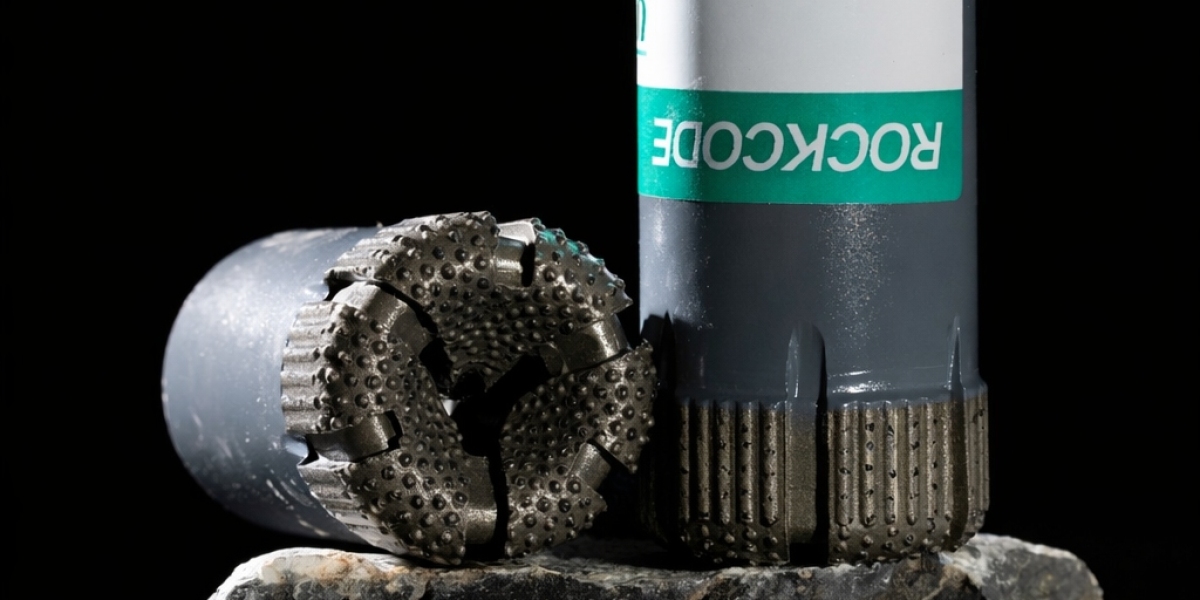

A field-focused note for core logging and rig decisions.
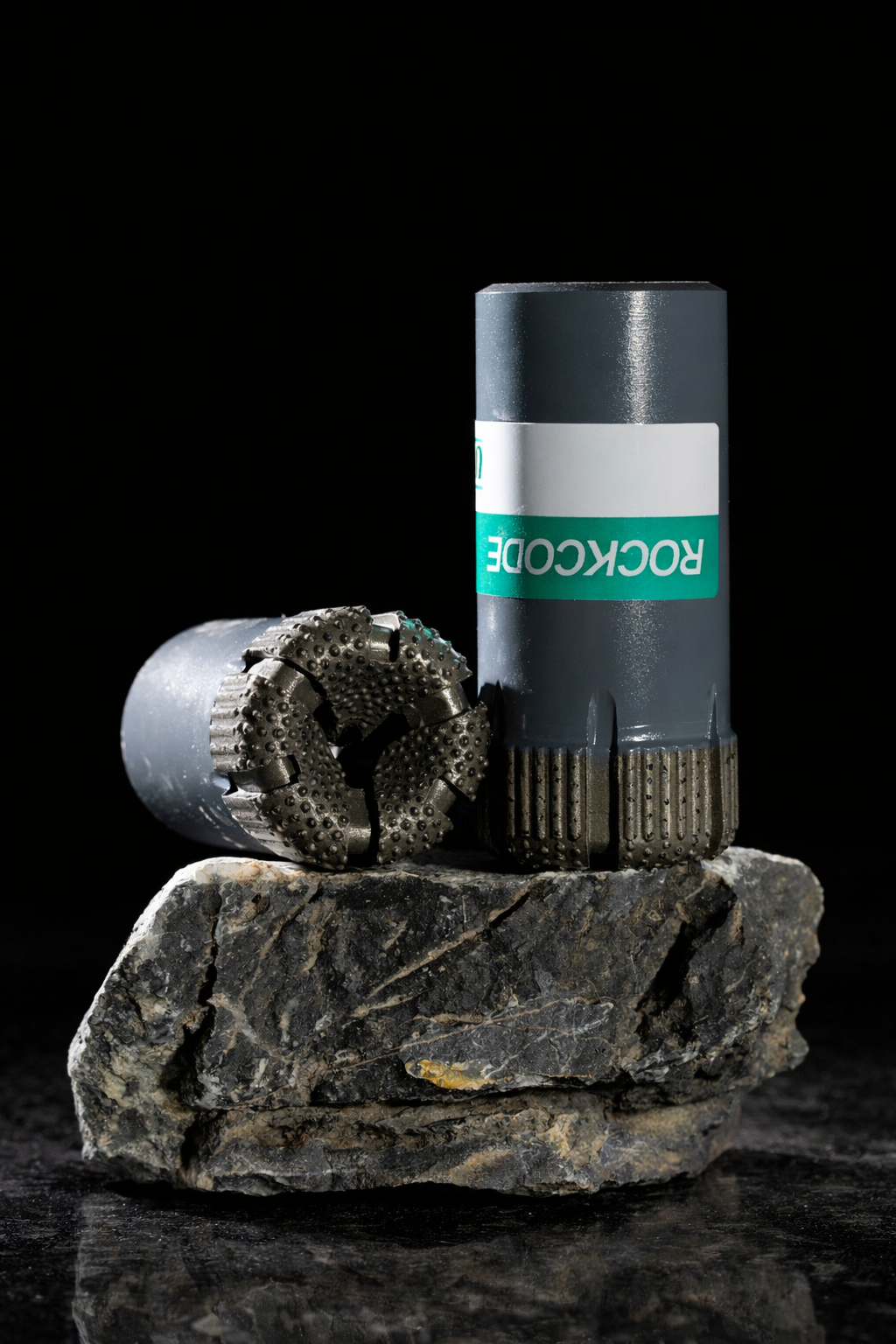
Diamond core bits shown with a hard rock sample (equipment context).
The terms [1] below help drillers, geologists, and core loggers stay aligned on what is in the hole and why it behaves the way it does.
Three rock families used in day-to-day core logging
Igneous rocks
Igneous rocks form when molten material solidifies.
Intrusive igneous rocks cool at depth. Crystal growth has time to develop.
Extrusive igneous rocks cool at or near surface. Crystals stay fine or the rock turns glassy.
Volcaniclastic rocks are fragmental material from explosive activity.
Tuff: fine fragments.
Volcanic breccia: coarse, angular fragments, commonly cemented.
Breccia vs conglomerate (field cue): breccia clasts are typically angular and can be compositionally uniform. Conglomerate clasts are commonly rounded and often mixed rock types.
Sedimentary rocks
Sedimentary rocks form from older rock fragments deposited as particles, usually under water.
Common settings: beach and offshore deposits of pebbles, sand, mud, and mixtures.
Also includes chemically and organically formed deposits (e.g., limestone, iron formation, diatoms, chert).
Metamorphic rocks
Metamorphic rocks are altered from an original rock by heat, pressure, and earth movement.
Common transformations referenced in logs:
Mud → graywacke
Shale → slate
Sandstone → quartzite
Limestone → crystalline limestone or marble
Some granites/syenites → gneiss
Various igneous rocks → slates, schists, talc rock, serpentinite
Texture is controlled by cooling rate
Texture changes because crystals need time and suitable temperature conditions to grow.
Slow cooling
Slow cooling produces coarser crystals.
Typical examples include:
Granite, syenite, granodiorite, diorite
Many porphyries and diabase variants
Pegmatite (very coarse crystallization; may carry accessory minerals)
Fast cooling
Fast cooling produces fine-grained or glassy textures.
Common settings include:
Lavas at surface or under water
Chilled margins along dikes and intrusions
Rocks with the same name can drill differently when alteration, grain size, abrasive phases, or fracturing change.
“Acid” and “basic” in legacy drill literature
Older drill manuals often use “acid” and “basic” as shorthand tied to silica content and mineral assemblage.
Quartz (SiO₂) is a major rock-forming component in many igneous rocks.
Higher SiO₂ is one basis for classification in older schemes.
High-silica rocks (e.g., granite, rhyolite) are commonly lighter in colour and lower in specific gravity than lower-silica rocks (e.g., diorite, andesite, gabbro, diabase, basalt).
This approach does not cover fragmental volcanic rocks (tuffs, breccias). Those are treated separately.
Practical igneous naming map (silica + emplacement + texture)
Use this as a naming aid in logs. It helps connect rock name to emplacement and texture.
Silica / trend | Intrusive, cooled at depth (granular) | Shallow intrusives (porphyritic / fine groundmass) | Extrusive, fine-grained | Extrusive, glassy | Extrusive, porous |
Higher SiO₂ | Granite; Aplite | Quartz-porphyry; granite-porphyry; felsite; aplite dikes | Rhyolite | Obsidian | Pumice |
Intermediate | Syenite; Granodiorite | Syenite-porphyry; lamprophyre; plagioclase-porphyry / porphyrite; diorite-porphyry | Trachyte; Andesite / Dacite | Obsidian (can occur) | Pumice (can occur) |
Lower SiO₂ | Gabbro; Dunite | Diabase; Dolerite | Basalt | — | — |
Alteration signatures commonly seen in core
Greenstone-style alteration (chloritization)
Many “greenstones” in older texts refer to altered andesites, dacites, and related lavas.
Mafic silicates can alter to chlorite.
A common field signature is gray-green colour.
Alteration often varies across short intervals.
Carbonation by CO₂-bearing fluids
Some rocks alter through CO₂-bearing fluids to form carbonates.
A common field cue is rusty red weathering.
Alteration may also appear as white or green zones.
Sulphide oxidation
Iron pyrite and other iron sulphides can oxidize and hydrate.
Common products noted in legacy references include limonite and hematite.
Field cues include staining, friable zones, and local weakening.
Weathering of granitoids
Weathering combines mechanical breakdown and chemical reactions.
Quartz commonly persists as sand-sized grains.
Feldspar commonly alters to clay and soluble salts.
Hornblende and biotite can alter to clay or remain as flakes, depending on conditions.
Operational use in core drilling
Use consistent names (family + texture + key alteration).
Note chilled margins, porphyritic textures, and strong alteration zones.
Treat altered or weathered intervals as different ground, even if the base rock name stays the same.
→ For more information about ROCKCODE’s Products, please visit: https://www.rockcodebit.com/geotechnical-core-bits
→ Email us at: info@rockcodebit.com
→ Information in this article is for general reference only. For specific drilling projects and drilling bits, please consult qualified professionals. Thank you.
Source
【1】Cumming, J. D. (1956). Diamond drill handbook. (2nd ed.). Smit
https://www.rockcodebit.com/rock-basics-for-diamond-core-drilling.html