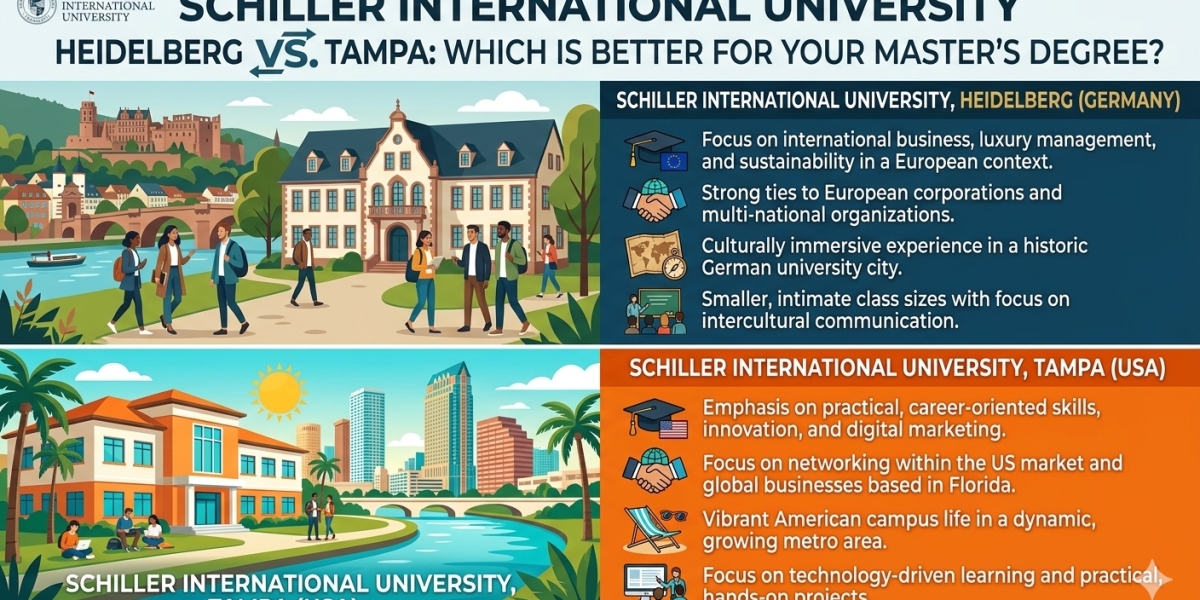

Here is a question we get more often than you would think. A student comes to us with a brochure for Schiller International University. They see the same degree name listed under two different locations Heidelberg and Tampa. Same university. Same curriculum. Same American credits. But the price tags look different, the visa rules are completely different, and the career outcomes do not match at all.
So which one is actually better?
The honest answer is that it depends entirely on where you want to work afterwards. But let me walk you through the real differences, because most consultants just read you the brochure. We have placed students at both campuses. The patterns are clear.
The Core Difference You Need to Understand First
Schiller runs on a distributed campus model. You can start in Heidelberg, spend a semester in Madrid, and finish in Tampa. That flexibility is real . But most students pick one home campus and stay there, and that choice has consequences.
Schiller International University Heidelberg operates as a European campus with European costs and a European lifestyle. Tuition runs around €16,560 per year for most master's programs . That translates to roughly $19,620 USD at current exchange rates.
Schiller International University Tampa is the American campus. Tuition sits at $19,410 per year for most programs . On paper, that looks similar. But the numbers hide the real story.
The Visa Question That Decides Everything
Let me be blunt. If you are an international student who wants to work in the United States after graduation, Heidelberg cannot help you with that.
The Tampa campus offers something Heidelberg simply does not have: Optional Practical Training, or OPT. This is a US government program that allows F-1 visa students to work in America for up to twelve months after completing their degree. If your degree falls under STEM and several Schiller programs do that extends to thirty-six months .
Here is the catch that most students miss. To qualify for OPT, you must complete at least your final academic year on the Tampa campus. You cannot study entirely in Heidelberg and then show up asking for American work authorization. That is not how it works.
So if your answer to where do you want to build your career is New York, Chicago, or San Francisco, Tampa is not just the better option. It is the only option that gives you a legal pathway to stay.
What Heidelberg Gives You Instead
Heidelberg cannot offer OPT. But it offers something Tampa cannot match either: proximity to the international institutions that actually hire in certain fields.
The Schiller International University Heidelberg campus sits in one of Germany's most prestigious university towns. More importantly, it is a short train ride from Geneva, Brussels, and Frankfurt—the headquarters of the UN, NATO, the European Central Bank, and countless NGOs .
For students in the Master of Arts in International Relations and Diplomacy, that geography matters. Your guest lecturers are people who actually work at these institutions. Your internship placements are real. Your network builds in the right places .
One of our students completed the International Relations MA at Heidelberg and landed a junior analyst role at a Geneva-based NGO within four months of graduation. She told us the university's connections were the only reason she got the interview. That does not happen from Tampa.
The Cost Reality Nobody Wants to Calculate
Let me give you numbers that actually reflect what students pay.
For a master's program at Schiller International University Heidelberg, tuition is €16,560 per year . Living costs in Heidelberg run approximately €800 to €1,100 per month depending on your habits. Total for a twelve-month degree: roughly €26,000 to €30,000.
For Schiller International University Tampa, tuition is $19,410 per year . Living costs in Tampa run $1,200 to $1,800 per month depending on whether you have roommates and how close to downtown you live. Total for a twelve-month degree: roughly $34,000 to $41,000.
That is a significant difference. But here is the question you need to ask yourself: is the US salary premium worth the extra cost? An entry-level role in Tampa or New York might pay $60,000 to $80,000. An equivalent role in Berlin or Brussels might pay €45,000 to €55,000. The math works out differently for everyone.
Program Strengths at Each Campus
Both campuses offer the same core programs: MBA, MSc in Global Finance, MSc in Data Analytics, MSc in Sustainability Management, and MA in International Relations and Diplomacy .
But the emphasis shifts by location.
Tampa has stronger ties to American corporate networks. The MBA program there feeds into consulting, finance, and tech roles across Florida and the East Coast. The Data Analytics program has direct recruitment pipelines to Tampa's growing fintech and health tech sectors .
Heidelberg has deeper connections to European and multilateral institutions. The Sustainability Management program partners with the United Nations Institute for Training and Research (UNITAR) for exclusive certifications . The International Relations program places graduates into EU institutions, UN agencies, and Berlin-based policy think tanks .
The Alumni Network Reality
Here is something the brochures will not tell you. Schiller's alumni network spans 130 countries, but where those alumni are concentrated matters .
Heidelberg graduates are scattered across Europe—Berlin, Brussels, Geneva, London. Tampa graduates cluster in Florida, New York, and Texas. Neither network is better. They are just different. Your choice should align with where you want to live.
We had a student who chose Heidelberg because she wanted to work in EU climate policy. Two years later, she is in Brussels. Another student chose Tampa because he wanted to break into American sports management. He is now in Miami. Both made the right call for their specific goals.
Which One Should You Choose?
Let me give you a decision framework that actually works.
Choose Schiller International University Heidelberg if:
You want to build a career in Europe, at an international organization, or in EU policy
You prefer a smaller, more traditional European university town over an American city
Your budget is tighter and the lower Euro cost of living matters to you
OPT and US work authorization are not priorities
Choose Schiller International University Tampa if:
You want to work in the United States after graduation (OPT is your pathway)
Your target industry is American corporate—finance, tech, consulting, healthcare
You are comfortable with higher living costs in exchange for US salary potential
You want the option to transfer to European campuses later without losing US work eligibility
Both campuses deliver the same American-accredited degree. Both have small class sizes one alum described it as a relief compared to lectures with two hundred other students . Both give you access to Schiller's multi-campus network if you want to move around.
But they lead to different job markets, different visa situations, and different price points. There is no universal better. There is only better for you.
One final honest note: We have seen students pick Tampa solely for OPT, struggle with the higher costs, and leave before finishing. We have seen students pick Heidelberg for the romance of Germany, ignore the visa reality, and scramble to find European sponsorship after graduation. Neither mistake was necessary. Run your own numbers. Know your own priorities. Then choose.