
Bidding new construction electrical work in the U.S. involves carefully estimating materials, labor, overhead, and profit while aligning with project plans, timelines, and code requirements. A well-executed bid will find the right balance between competitiveness and profitability; at the same time, it will specify the scope of the work so there will be no need for further unforeseen costs.
Electrical contractors in the construction field today are expected to produce bidding proposals very quickly and accurately, while working with fluctuating material prices and meeting compliance standards. Many contractors are now turning to construction estimates to streamline their bidding process, reduce errors, and stay competitive without overloading internal teams.
Understanding the Electrical Bidding Process
The first step in electrical bidding consists of figuring out the total amount of money needed for the execution of the electrical part in the construction project, and the next stage involves submitting this amount as a bid. Typically, in the United States, such an activity requires careful preparation and thorough documentation, especially for commercial and large-scale residential developments.
Roughly speaking, there are two main categories of bidding. Hard bids are more competitive, and the lowest qualified bidder usually wins; however, the bids have to be submitted in response to a public or private request. When it comes to negotiated bids, it is a matter of direct communication between the general contractor or owner and the electrical contractor to come to an agreement on the pricing.
The projects you get to work on may be as diverse as a single-family house, multi-unit residential buildings, commercial offices, and industrial facilities. Each time, a different degree of intricacy and skill is required, which means it is quite important that the way you work be aligned with the scope of the project.
Reviewing Project Plans and Specifications
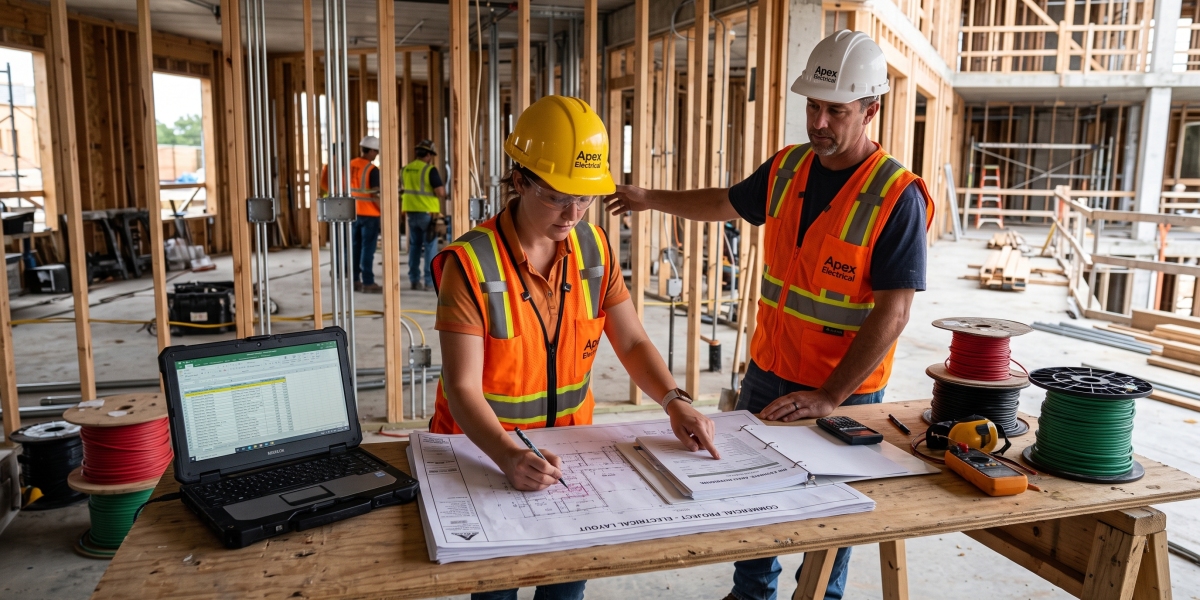
Before analyzing figures, the initial step is to examine the project blueprints and documentation. The electrical schematics depict in detail the phase distribution, panel boards, lighting, and electrical installations.
The contractor will have to analyze thoroughly:
- Illumination arrangements
- Electrical distribution networks
- Manufacturing timings
- Some systems, such as fire alarm or data transmission wiring
In the United States, adhering to the National Electrical Code is compulsory. Besides ensuring safety and uniformity throughout projects, however, local authorities may have other requirements; therefore, checking for the city's or the state's changes is equally important.
Neglecting to capture the full scope at this point might save some components, which very often is the cause for underbidding and experiencing losses.
Making An Accurate Electrical Quantity Survey
In fact, it is at an electrical quantity survey that the project begins to be represented numerically. The activity consists of determining the quantity of each element needed for the job, including the wiring and ducts, the outlets, and the panels.
Accurate electrical quantity surveys make certain that nothing is missed. Estimating is done with the help of digital equipment or software that enhances accuracy and efficiency. They enable quicker measurements and calculations that are automatic, thus leading to the elimination of human error to a great extent.
The secret lies in being orderly and sticking to the schedule. Even the tiniest errors, like forgetting a couple of fixtures per floor, can make a big difference in the case of the overall proposal when multiplied on a large-scale project.
Estimating Material Costs
Material costs are one of the most changeable aspects of electrical bids in the U.S. market. The amount you pay for copper wire, conduit, and electrical equipment may go up or down because of changes in the supply chain and economic conditions.
Below is a very simplified list of the major material categories:
Material Category | Examples | Cost Considerations |
Wiring & Cabling | Copper wire, data cables | Price volatility, length |
Conduit & Raceway | PVC, EMT, flexible conduit | Type and installation complexity |
Panels & Breakers | Distribution panels, circuit breakers | Brand and capacity |
Fixtures | Lighting, switches, outlets | Quantity and quality |
Specialty Systems | Fire alarm, security systems | Code compliance |
Including a waste factor, usually between 5% and 10%, helps to cover the material loss or the extra requirement that might come up unexpectedly.
Besides, establishing a good rapport with suppliers might also lead to securing better rates and thus enhancing the competitiveness of the bids.
Estimating the Cost of Labor
Labor typically represents the biggest share of an electrical bid. It is one of the areas that call for precision in estimating the length of time needed to carry out each operation.
Labor units that indicate the average time required for the installation of components are a common tool for U.S. contractors. The units are subsequently multiplied by the total number after the takeoff.
In many projects, accurate results from electrical estimating outsourcing depend on understanding crew productivity, job site conditions, and scheduling constraints. For example, a project with tight deadlines or limited site access may require additional labor, increasing overall costs.
Besides, things such as union labor rates, prevailing wage rates, and different types of labor in various regions also have to be taken into account, especially in the case of public and government-funded projects.
Including Overhead and Profit in Bids
After figuring out the direct costs, you still have to add the overhead and the profit to finish the bid.
The overhead represents the costs that are not directly linked to a particular project but without which the running of a business would hardly be possible.
Here is the list of the average overhead costs:
- Office-related spending
- Insurance and bonding
- Equipment and tools
- Administrative payrolls
Proprietary margins in the U.S. electrical contracting sector are usually between 10% and 20%. The deciding factors are project size, risk, and how tight the competition is.
See the basic example here:
Cost Component | Description |
Direct Costs | Materials + labor |
Overhead | Business operating expenses |
Profit | Desired earnings margin |
The key is the constant adjustment of these components. An offer that is excessively high might result in missing the project, whereas a very low offer might cause that business to operate at a loss or under financial stress.
Understanding Permits, Codes, and Compliance
To guarantee the safety and quality of the work, electrical work in the U.S. is subject to stringent regulations. Contractors should get the right permits to work and plan for inspections at different phases of the construction.
Types of permits are location-dependent but usually include:
- Electrical permits
- Building permits
- Inspection approvals
While being compliant with the National Electrical Code is necessary, local authorities might impose even more stringent regulations. Non-compliance may lead to delays, fines, or rework, which negatively influence project profitability.
Allowing for inspections and approvals when bidding can help in avoiding scheduling conflicts and enhancing the project implementation.
Submitting a Professional Bid Proposal
Just a number is not what a thoughtfully constructed bid proposal represents; it is a comprehensive package built by demolition estimators to reflect one's capability, professionalism, and transparency.
Some of the vital elements of a good bid proposal are:
- Description of the work to be done
- Detailed cost analysis
- Overall duration of the project
- Contract stipulations
- Points excluded from the bid and base assumptions
Besides content, how you present your proposal is equally important. A neat layout is always appreciated; besides, it makes a good impression.
Common Mistakes to Avoid
Even very experienced contractors make mistakes that cost them hugely in the bidding process. A major error that is commonly made is underestimating the amount of work involved, which results in missing parts and lower profits.
In addition to that, a very common problem is not taking into consideration the changes in the prices of materials. You can avoid this risk if you get the supplier quotes locked in or include escalation clauses.
At the same time, bad documentation is a very big issue. If you don't have clear records, it is hardly possible to justify the expenses or solve disagreements. Last but not least, not communicating what is excluded can cause misconceptions with the clients or general contractors.
How to Get More Electrical Project Contracts
Just being able to supply the right numbers is not enough to get you winning bids consistently. In addition, you need to build great relationships with general contractors as well as project owners because this will give you a big edge over your competition.
It is also very important that you develop accuracy in your estimates progressively. You will get very helpful clues if you study your old work in detail and identify where there were discrepancies between the estimated and actual costs.
Besides that, in the present times, tech is also a big factor. Choosing good modern estimating tools not only spares you tons of time and helps in cutting down errors but also unlocks the opportunity for contractors to concentrate on the business side rather than on doing manual calculations.
In the highly competitive U.S. market, consistency, professionalism, and a great eye for detail are the qualities that differentiate top-tier contractors from the rest.
Conclusion
Estimating the cost of new construction electrical work entails both a technical and strategic approach. It demands meticulousness, familiarity with U.S. laws, and a thorough understanding of expenses. So, by perfecting each stage, starting from takeoffs all the way to final proposals, you'll not only enhance your precision but also increase your chances of winning projects and establishing a thriving electrical contracting enterprise in your area.
FAQs
1. How do electrical contractors price new construction jobs?
They determine total expenses by adding up materials, labor, overhead, and profit margins, while ensuring that the results fit the project scope and comply with local regulations.
2. What is the average profit margin for electrical work in the U.S.?
On average, contractors aim for a profit margin of 10% to 20% based on the project complexity and level of competition.
3. Why is the NEC important in electrical bidding?
The National Electrical Code clearly spells out all the safety requirements for electrical work, thereby making it indispensable in project planning and cost estimation.
4. How long does it take to prepare an electrical bid?
Depending on the size and complexity of the project, the timeframe varies from a few hours to several days.
5. Should small contractors outsource estimating?
Absolutely. Construction estimating outsourcing can be a time-saving measure, improve estimation accuracy, and allow contractors to concentrate on delivering projects and growing their businesses.