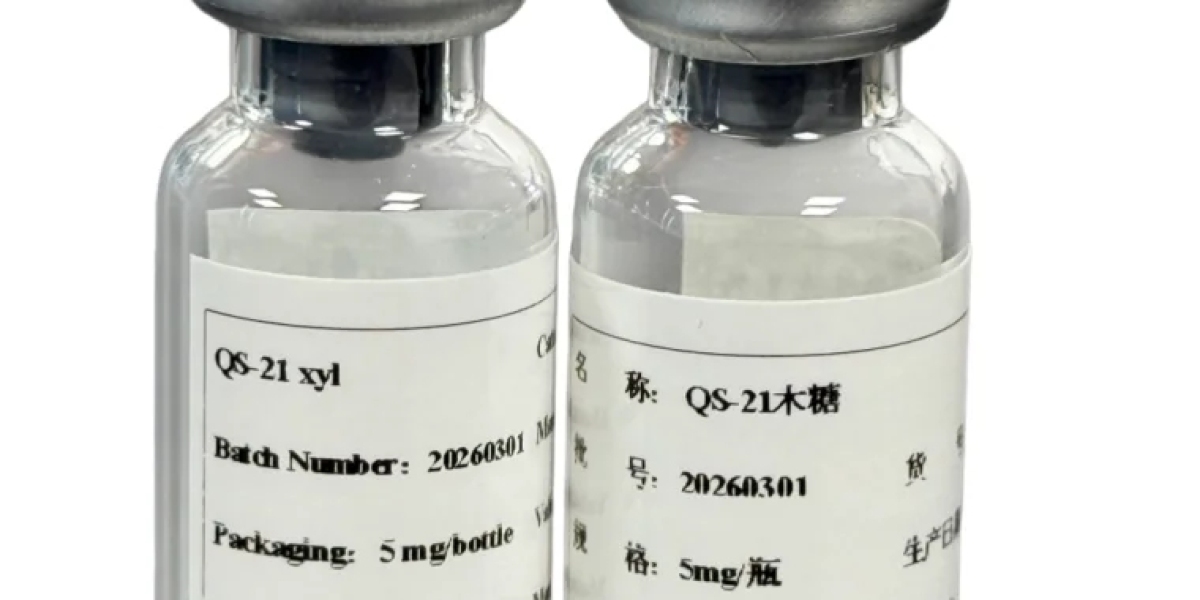

1. Introduction to QS-21
Basic Definition: QS-21 is a mixture composed of two saponin molecules, naturally present in Quillaja saponaria(commonly known as Quillay), a tree species endemic to Chile.
Core Function: It is one of the most potent adjuvants currently known, capable of significantly enhancing and modulating the immune response to vaccine antigens. In most formulations, it is used in combination with another adjuvant, MPL, exhibiting remarkable synergistic effects.
Scarcity and Cost: The yield of QS-21 in trees is extremely low, and the extraction process is complex, making it one of the most expensive molecules globally, with reported costs ranging from $100,000 to $400,000 per gram.
Physical Properties: Saponins exhibit soap-like foaming characteristics when dissolved in water.
2. History of Saponin Extracts
Traditional Use: Extracts from Quillaja saponariahave been used by indigenous peoples in Chile (such as the Mapuche) for hundreds or even thousands of years, initially mainly as soap.
Scientific Discovery: In 1991, Charlotte Kensil and her colleagues discovered that the QS-7 and QS-21 fractions in Quillajaextracts had low toxicity and high adjuvant activity.
Process Evolution: Early production relied on felling entire trees and stripping bark. Recent innovative technologies (total biomass method) allow saponin extraction from pruned branches, significantly reducing tree felling.
Due to supply constraints of natural Chilean Quillaja saponariaresources and extremely high extraction costs, the industry is actively developing multiple alternative production pathways. The following is a detailed introduction to the preparation of QS-21 via plant cell culture, biosynthesis and chemical synthesis:
(1) Plant Cell Culture Technology (cpcQS-21)
This is currently the most advanced alternative solution with the greatest commercialization potential, led by SaponiQx, a subsidiary of Agenus.
Preparation Principle: Quillaja saponariacells are cultured in controlled bioreactors to continuously produce QS-21 molecules without relying on natural forests. This method is called "cpcQS-21".
Key Advantages:
Environmental Independence: Production is no longer affected by Chile’s climate, droughts or forest fires.
High Yield and Efficiency: Reportedly, the concentration of QS-21 in cell cultures is orders of magnitude higher than that extracted from bark, and the production cycle is shortened from decades (tree maturity period) to weeks.
Consistency: The controlled environment ensures highly uniform quality and purity across batches.
Progress: SaponiQx has successfully achieved kilogram-scale cGMP production, and plans to reach ton-scale capacity in the coming years.
(2) Chemical Total Synthesis and Semi-synthesis
Due to the extremely complex structure of the QS-21 molecule (containing branched triterpenes, complex sugar chains and acyl chains), total synthesis is highly challenging.
Total Synthesis:
Current Status: First completed by Ginette Wesselborg and the Sloan Kettering Institute, requiring more than 50 chemical steps.
Limitations: Due to the excessive number of steps, the total yield is extremely low, making it currently cost-prohibitive for commercial scale production.
Semi-synthesis:
Method: Chemically convert structurally similar, easier-to-obtain saponin precursors (such as low-activity saponins extracted from common varieties) into QS-21.
Significance: This approach allows scientists to fine-tune molecular structures to develop second-generation adjuvant analogs with lower toxicity and better stability.
(3) Biosynthesis and Synthetic Biology
This is regarded as the "ultimate solution" to the cost problem, aiming to transfer the genetic code for QS-21 production from Quillaja saponariainto microorganisms.
Preparation Principle: Identify and clone the complete set of enzymes responsible for QS-21 synthesis in Quillaja saponaria, then introduce them into yeast or E. coli. Through a fermentation process similar to brewing, microorganisms can secrete large amounts of QS-21.
Technical Challenges: The biosynthesis of QS-21 involves complex metabolic pathways, and scientists have not yet fully identified all relevant enzymes and catalytic steps.
Prospects: Once breakthroughs are made, the production of QS-21 will be as cheap and infinitely scalable as insulin production, with the potential to reduce the cost per gram from tens of thousands of dollars to hundreds of dollars.
(4) Vertical Farming and Aeroponics
As a transitional innovation, some companies (such as AmerStem) adopt different botanical approaches.
Preparation Principle: Rapidly cultivate dwarfed Quillaja saponariatrees in fully controlled indoor environments using aeroponics (roots suspended in air, sprayed with nutrient solution).
Features: QS-21 is extracted from young leaves and stems rather than traditional bark, enabling high-frequency harvesting without felling trees.
Table: Supply and Demand of Vaccines Containing QuillajaSaponin Adjuvants
Supply and Demand of Vaccines Containing QuillajaSaponin Adjuvants | ||||||
Vaccine | Current Production Capacity | Projected Demand | Future Capacity | |||
Vaccine Doses per Year | QS-21 Equivalent (kg) | Projected Demand (Doses/Year) | QS-21 Equivalent (kg) | Planned Future Production Capacity (Doses/Year) | QS-21 Equivalent (kg) | |
Malaria | ||||||
Mosquirix/RTS,S (GSK) | 8 | 0.2 | By 2030: 80–100 million (all malaria vaccines combined) | 2.0–5.0 | 15 | 0.375 |
R21/Matrix-M (Novavax) | 25 | 1.25 | Matrix-M adjuvant: unknown; formulated vaccine: 200 million | 10 (assuming Matrix-M production keeps pace with formulated vaccine capacity) | ||
COVID-19 | ||||||
Nuvaxovid (Novavax) | 0.4 | 0.003 | Negligible | / | / | / |
Herpes Zoster | ||||||
Shingrix (GSK) | 23 | 1.135 | / | 1.135 | / | 1.135 |
Tuberculosis | ||||||
M72/AS01E (GSK) | / | / | 12 million – 246 million (by 2035) | 0.3–6.15 | 52 million – 144 million (by 2035) | 1.3–3.6 |
Respiratory Syncytial Virus (RSV) | ||||||
Arexvy (GSK) | 8 | 0.2 | 50 | 1.25 | / | 0.2 |
Total Annual QS-21 Demand (kg/year) | / | 2.8 | / | 4.7–13.5 | / | Uncertain |
3. Manufacturer and Supplier Information
Leading Supplier: Desert King (DK) is currently the world’s largest supplier of Quillaja saponaria (Quillay) extracts and the exclusive supplier of QS-21 for all approved human vaccines. The company has production bases in Chile, Mexico, the United States and Italy.
SaponiQx (Agenus Subsidiary): Focuses on producing QS-21 via plant cell culture (cpcQS-21), and has reached kilogram-scale cGMP production standards.
AmerStem: Adopts aeroponics and vertical farming technologies to extract high-yield QS-21 from the leaves of dwarfed Quillaja saponariatrees.
Others: Including Q-VANT, Chile Botanics, Plantae Labs, Botanical Solution Inc., Alkion BioInnovations, GCBiotech, etc.
Table: Competitors in the QuillajaProduct Market
Competitors in the QuillajaProduct Market | ||
Company | Export Market Share of QuillajaProducts | Sector |
DK | 44% | Vaccine adjuvants, animal feed, agriculture, food & beverage, personal care & cosmetics, mining |
Plantae Labs | 21% | Animal feed, agriculture |
Chile Botanics S.A. | 15% | Animal feed, agriculture, food & beverage |
Surtrade Export & Import Ltda. | 8% | / |
Fitotek | 7% | Animal feed |
Aguamar | 4% | Food & beverage |
BASF Chile S.A. | <1% | Agriculture |
Tresmontes | <1% | Food & beverage |
Anaproc. S.A. | <1% | Animal feed |
Q-VANT | / | Vaccine adjuvants |
4. QS-21-containing Adjuvant Systems and Vaccines
According to the report, the main QS-21-containing adjuvant systems and their applications are as follows:
Table: QS-21-containing Adjuvant Systems/Vaccines
Adjuvant System | Company | Core Components | Upstream Supplier | Product Name & Holder | Indication |
AS01B | GSK | 50 mcg QS-21 + 50 mcg MPL | Corixa (GSK), Agenus, DK | Shingrix (GSK) | Herpes zoster |
AS01E | GSK | 25 mcg QS-21 + 25 mcg MPL | Corixa (GSK), Agenus, DK | RTS,S (Mosquirix) (GSK) | Malaria |
Arexvy (GSK) | Respiratory syncytial virus (RSV) | ||||
M72/AS01E (Gates MRI/GSK) | Tuberculosis (TB) | ||||
Matrix-M | Novavax AB | Matrix C (QS-21); Matrix A (QS-7); other QS fractions | Novavax AB; CMO manufacturers AGC Biologics A/S and Polypeptide Group; DK | Nuvaxovid (Novavax) | COVID-19 |
R21/Matrix-M (Jenner Institute/Novavax) | Malaria | ||||
ALFQ | MHRP, WRAIR | 20 μg synthetic MPL (3D-PHAD) + 100 mcg QS-21 | DK | Preclinical data only, not yet entered clinical trials | / |
SQ | Vaccine Formulation Institute | Squalene + QS-21-containing saponin oil-in-water emulsion | DK | Preclinical data only, not yet entered clinical trials | / |
LQ | Vaccine Formulation Institute | QS-21-containing saponin liposome | DK | Preclinical data only, not yet entered clinical trials | / |
LMQ | Vaccine Formulation Institute | QS-21-containing saponin liposome + TLR4 agonist | DK | Preclinical data only, not yet entered clinical trials | / |
5. Clinical Progress and Application Pipeline
Tuberculosis Vaccine (M72/AS01E): One of the most important pipeline assets under development. Sponsored by the Gates Medical Research Institute, it is currently undergoing Phase III clinical trials involving 20,000 subjects, with results expected between 2027 and 2028. Early trials showed approximately 50% efficacy in preventing pulmonary tuberculosis.
Malaria Vaccine (R21/Matrix-M): Developed by the University of Oxford Jenner Institute and Novavax, manufactured by the Serum Institute of India (SII). It received positive WHO recommendation in 2023, and SII plans to reach an annual production capacity of 200 million doses by 2025.
ALFQ Adjuvant Pipeline: The ALFQ adjuvant developed by the US Army (WRAIR) is currently in multiple Phase I clinical trials targeting HIV, influenza, Campylobacterinfection, COVID-19 and malaria.
Other Research: Includes the development of alternative QS-21 production methods such as biosynthesis, full chemical synthesis and semi-synthesis, to address the vulnerability of natural supply sources.
Table: QS-21 Clinical Suppliers
Supplier for Clinical Use | Current Manufacturing Capacity (annual QS-21 output) | Future Manufacturing Capacity (annual QS-21 output) | |
Production Site/Type | |||
DK | QS-21 precursor material | 10 kg | 20 kg (from 2026 onwards) |
DK | cGMP QS-21 (Quillajaextract) | 1 kg | 5 kg (near-term expansion), 10 kg (long-term expansion plan) |
GSK/Agenus (purifies precursor from DK) | cGMP QS-21 (Quillajaextract) | ≥1.5 kg | / |
Novavax/CMO (purifies precursor from DK) | cGMP QS-21 (Quillajaextract) | ≥1.25 kg | / |
Q-VANT | cGMP QS-21 (Quillajaextract) | 1 kg | 10 kg |
SaponiQx | cGMP cpcQS-21 (plant cell culture) | Kilogram-scale | / |
Botanical Solution/Croda | cpcQS-21 (plant cell culture) | Several kilograms (non-GMP) | GMP capacity planned for 2025–2026 |
Maxvax | cGMP QS-21 (Quillajaextract) | / | 1 kg |
/ | cGMP synthetic QS-21 analog | / | / |
Alkion BioInnovations | cGMP QS-21 (plant tissue culture) | Negligible | / |
AmerStem | cGMP QS-21 (plant tissue culture) | 2 kg/year (near-term) | >14 kg/year |
Potential Suppliers for Other Uses | / | / | |
Chile Botanics | / | / | |
Plantae Labs | / | / | |
Fitotek | / | / | |
BASF Chile | / | / | |
Tresmontes | / | / | |
Anaproc | / | / | |
Summary
Looking ahead, the production of QS-21 will completely break away from dependence on Chile’s single natural resource, and fully transform towards more efficient and environmentally friendly synthetic biology and chemical synthesis routes. With the explosion of global recombinant protein vaccine pipelines, establishing a stable and independently controllable adjuvant supply chain has become a strategic priority for biosecurity.
In this process, domestic Chinese innovative enterprise GCBiotech has demonstrated strong competitiveness. Targeting the pain points of QS-21’s complex structure and restricted natural extraction, GCBiotech has successfully achieved scalable, high-purity production of QS-21 using its innovative adjuvant technology platform. This not only breaks the long-term monopoly of international giants on high-end adjuvant raw materials, but also significantly reduces the production cost of end-use vaccines through technological innovation. As a pioneer of domestic substitution, GCBiotech will strongly support the independent R&D of China’s new-type vaccines (such as tuberculosis, malaria and broad-spectrum anti-cancer vaccines), contributing a "Chinese solution" to global public health.
http://en.jicangbio.com/overview-of-suppliers-pipeline-applications-and-technical-routes.html