
Partnerships can help businesses enter new markets, access new capabilities, expand distribution, and build long-term commercial relationships. However, every partnership also introduces financial, operational, legal, and reputational risks. A partner's problems can sometimes affect the organization connected to it, making proper verification important before entering into a business relationship.
Partnership due diligence is the process of evaluating a potential business partner before signing an agreement or starting a commercial relationship. It involves reviewing the partner's financial position, ownership, management, legal history, compliance record, reputation, and operational capabilities.
For banks, NBFCs, fintech companies, lenders, insurers, and enterprises, a structured due diligence process can support better risk management while helping teams make faster and more informed partnership decisions.
Table of Contents
- What Is Partnership Due Diligence?
- Why Is Partnership Due Diligence Important?
- What Should Be Checked During Due Diligence?
- Partnership Due Diligence Process
- Role of Technology in Partner Due Diligence
- Benefits of Effective Due Diligence
- Best Practices
- FAQs
- Conclusion
What Is Partnership Due Diligence?
Partnership due diligence is a structured assessment of a company or organization before entering into a partnership, strategic alliance, distribution arrangement, lending relationship, or other commercial engagement.
The purpose is to understand who the potential partner is, how financially stable it is, whether it complies with applicable requirements, and whether there are risks that could affect the proposed relationship.
Depending on the nature of the partnership, organizations may review:
- Company registration and corporate structure
- Directors and promoters
- Ownership information
- Financial performance
- Credit and debt exposure
- Tax and regulatory compliance
- Litigation and legal records
- Business operations
- Industry position
- Reputation and adverse developments
- Existing business relationships
For example, a fintech company considering a partnership with a financial services provider may review the provider's corporate information, management, compliance record, financial stability, regulatory position, and litigation history before entering into an agreement.
Why Is Partnership Due Diligence Important?
Reduces Business Risk
A partnership can create dependencies between two organizations. If one partner faces financial or regulatory problems, the other organization may experience operational disruption, financial loss, or reputational damage.
Supports Better Decision-Making
Due diligence provides decision-makers with evidence rather than relying only on presentations, references, or information supplied by the prospective partner.
Protects Reputation
Customers often associate business partners with one another. Working with a company involved in serious legal or compliance issues can create reputational concerns.
Strengthens Compliance
For regulated businesses, assessing partners is an important part of managing third-party and counterparty risk.
Improves Operational Planning
Understanding a partner's capabilities, financial strength, technology, and operational infrastructure can help businesses assess whether the partnership is realistically sustainable.
What Should Be Checked During Partnership Due Diligence?
Corporate and Ownership Verification
Organizations should verify the partner's legal identity, registration details, business structure, directors, promoters, and ownership information.
Changes in ownership or management can also provide important context about the company's stability and governance.
Financial Due Diligence
Financial statements, revenue, profitability, cash flow, debt, liquidity, and other relevant indicators can help assess financial health.
A partner experiencing declining revenue and increasing debt may require additional review before a long-term commitment is made.
Legal and Litigation Checks
Organizations should identify significant lawsuits, regulatory proceedings, insolvency-related matters, or other legal events that could affect the partnership.
Compliance Assessment
Tax, corporate, licensing, regulatory, and industry-specific compliance should be evaluated based on the nature of the partnership.
Operational Capability
Financial strength alone does not guarantee that a partner can deliver on its obligations. Businesses should assess technology, infrastructure, workforce, service capacity, geographic coverage, and relevant operational capabilities.
Reputation and Market Standing
Negative media coverage, regulatory actions, customer complaints, or significant adverse events may warrant further investigation.
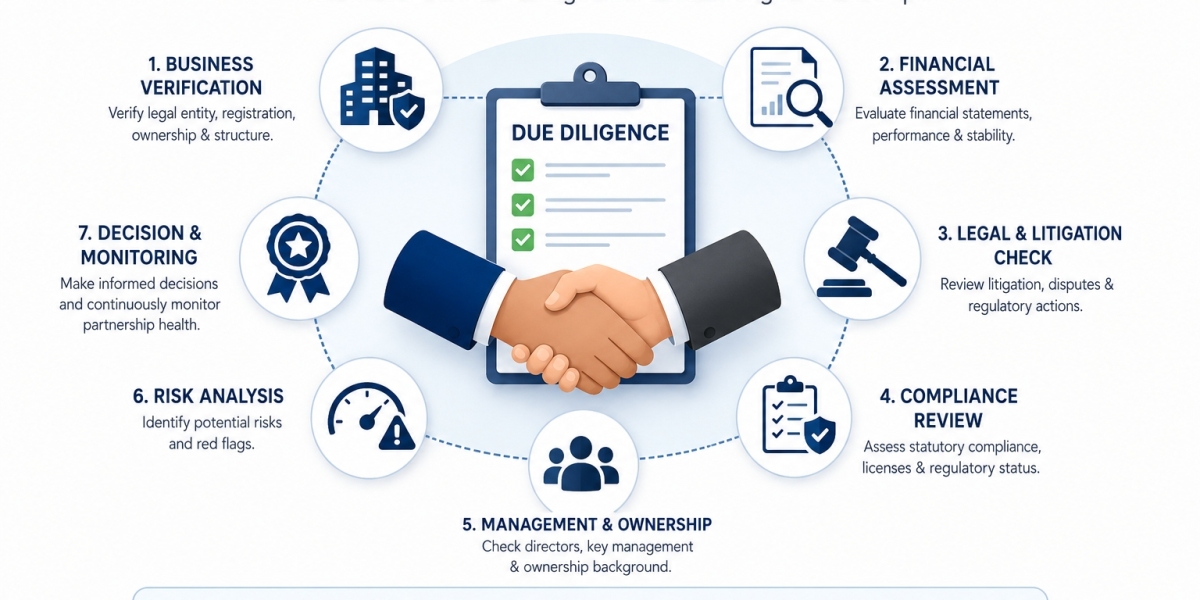
Partnership Due Diligence Process
A structured process makes partner evaluation more consistent.
1. Define the Scope
Determine what needs to be assessed based on the type, size, duration, and risk level of the proposed partnership.
2. Collect Partner Information
Gather corporate, financial, legal, compliance, operational, and ownership information from reliable sources.
3. Verify Key Information
Information provided by the prospective partner should be compared against independent records where possible.
4. Identify Risk Indicators
Look for financial stress, litigation, compliance issues, ownership changes, governance concerns, or operational weaknesses.
5. Assess Overall Risk
Risk teams can categorize the partner based on the severity and likelihood of identified issues.
6. Make the Partnership Decision
The business may approve the partnership, request additional safeguards, negotiate specific contractual protections, conduct enhanced due diligence, or decide not to proceed.
7. Continue Monitoring
Due diligence should not always end after the agreement is signed. Material changes in a partner's business can create new risks during the relationship.
Role of Technology in Partnership Due Diligence
Technology can make due diligence more efficient, especially when organizations evaluate a large number of business partners.
A business intelligence or risk platform can bring corporate, financial, legal, compliance, and ownership information into a centralized profile.
Automated Data Collection
Automation can reduce manual searches across multiple sources.
Risk Alerts
Systems can identify important changes such as litigation, compliance developments, management changes, or financial deterioration.
Centralized Profiles
A unified business profile allows teams to review relevant information without repeatedly collecting the same data.
Risk-Based Workflows
Technology can help route high-risk partnerships for enhanced review while allowing lower-risk cases to move through simpler workflows.
Benefits of Effective Partnership Due Diligence
A strong partnership due diligence process can help organizations achieve:
- Better partner selection
- Reduced third-party risk
- Improved financial risk assessment
- Stronger compliance oversight
- Better contract and negotiation decisions
- Reduced operational surprises
- Faster due diligence workflows
- Improved governance
- Better long-term relationship management
For example, an enterprise selecting a critical technology vendor may discover during due diligence that the vendor has a high customer concentration and weak financial liquidity. This does not automatically mean the partnership should be rejected, but it gives the enterprise an opportunity to negotiate stronger service continuity provisions or consider alternative suppliers.
Best Practices for Partnership Due Diligence
Use Reliable and Current Information
Outdated information can lead to poor decisions. Data should be refreshed before important partnership decisions.
Apply a Risk-Based Approach
Not every partnership requires the same level of investigation. Higher-value or higher-risk relationships should receive deeper review.
Document Findings
Key findings, risk assessments, approvals, and exceptions should be recorded for governance and future reference.
Combine Initial Due Diligence With Ongoing Monitoring
A partner's risk profile can change. Periodic reviews and event-based monitoring can help organizations identify important developments after onboarding.
Involve the Right Teams
Legal, compliance, finance, risk, procurement, and business teams may all provide valuable perspectives depending on the partnership.
Frequently Asked Questions
What is partnership due diligence?
Partnership due diligence is the process of evaluating a potential business partner's financial, legal, compliance, ownership, operational, and reputational profile before entering into a business relationship.
Why is partnership due diligence important?
It helps organizations identify potential risks before committing resources and can support better partner selection, stronger compliance, improved governance, and more informed commercial decisions.
What documents are commonly checked during partnership due diligence?
Depending on the relationship, organizations may review corporate records, financial statements, ownership information, regulatory documents, tax records, licenses, litigation information, and other relevant business documents.
How can technology improve partnership due diligence?
Technology can automate data collection, centralize business information, generate risk alerts, support risk-based workflows, and reduce the manual effort required to assess potential partners.
Should partners be monitored after due diligence?
Yes. Ongoing monitoring can help identify material changes in financial performance, ownership, management, compliance, litigation, or business operations that occur after the partnership begins.
Conclusion
Partnership due diligence provides a practical framework for understanding the risks and capabilities of a potential business partner before entering into a relationship. By reviewing financial health, ownership, management, compliance, legal history, operations, and reputation, organizations can make decisions based on a more complete view of the partner.
For banks, NBFCs, fintech companies, insurers, lenders, and enterprises, combining structured due diligence with technology-enabled monitoring can improve efficiency and strengthen third-party risk management.
The goal of due diligence is not simply to find reasons to reject a partner. It is to understand potential risks clearly, establish appropriate safeguards, and build business relationships on a more informed and sustainable foundation.