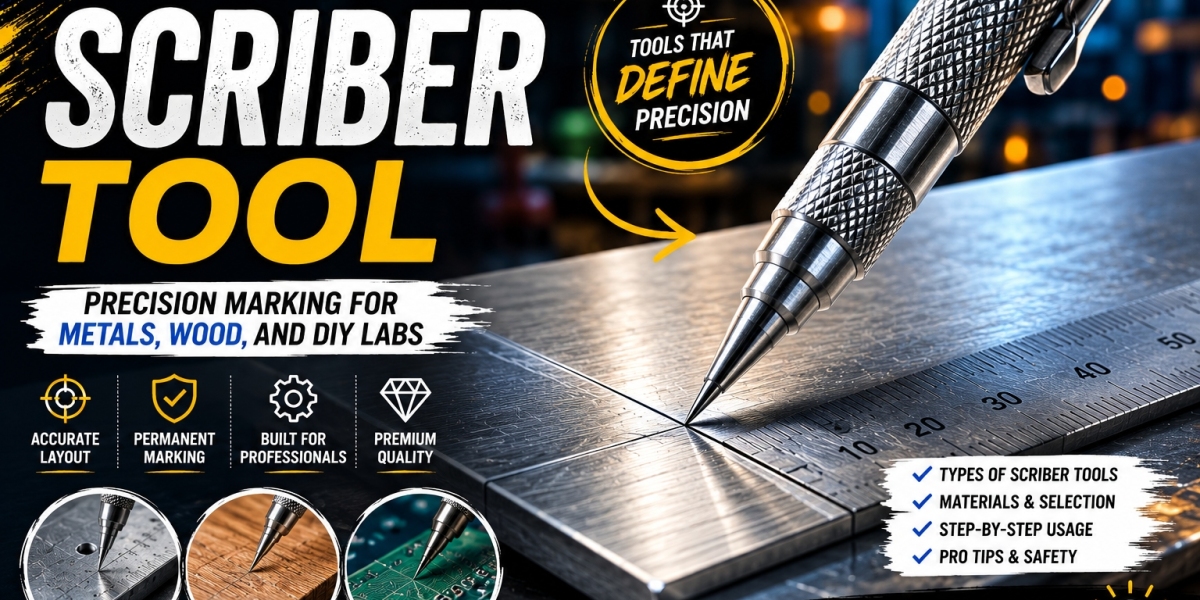

In high-precision craftsmanship, there is an unspoken rule: "If you can't see the line perfectly, you can't cut it accurately." While modern workshops are loaded with digital instruments and automated laser cutters, the baseline of absolute precision still rests on a deceptively simple, razor-sharp manual instrument: the scriber tool.
Whether you are fitting high-end custom cabinetry against an uneven stone wall, laying out complex geometric blueprints on a raw sheet of structural steel, or modifying custom electronics enclosures, a pencil or marker simply won’t cut it. Carbon leads smudge, ink lines bleed, and their physical width automatically introduces a margin of error up to 1mm.
When your tolerances are measured in fractions of a millimeter, you need a line that is clean, permanent, and infinitesimally thin. You need to drop the graphite and pick up a dedicated scriber tool.
This comprehensive technical guide unpacks everything you need to know about selecting, using, and mastering this essential layout tool across multiple industries.
What is a Scriber Tool? Understanding the Engineering Principles
A scriber tool (frequently referred to simply as a scriber or scratch awl in specific carpentry contexts) is a handheld engineering tool engineered to score ultra-fine, highly accurate lines onto hard workpieces prior to machining, cutting, or drilling.
The Core Mechanics of Scribing
Unlike a pencil that deposits a layer of material (graphite) on top of a surface, a scriber works through controlled mechanical displacement. By dragging a highly hardened conically ground tip across a material, it produces a shallow, sharp micro-scratch.
$$F_{\text{scribe}} > \text{Yield Strength of the Workpiece Material}$$
Because the line is physically engraved into the material substrate, it cannot be accidentally wiped away by oily hands, blown away by sawdust collectors, or dissolved by industrial chemical cutting fluids.
Why Pencils Fail Where Scribers Excel
The Tolerance Problem: A standard carpenter’s pencil creates a line that is roughly $0.5\text{mm}$ to $1.2\text{mm}$ wide. A precision tungsten-carbide scriber leaves a microscopic path that is less than $0.05\text{mm}$ wide.
Surface Contamination: On oily sheet metals, scaling steel, or wet hardwoods, ink and graphite fail to adhere. A scriber physically slices through surface contaminants directly into the base material.
Parallax Errors: Because pencil lead has thickness, aligning a cutting blade to the "left edge," "center," or "right edge" of a pencil line introduces a fluctuating margin of error. A scribed line provides a single, unambiguous physical groove that can literally trap the teeth of a handsaw or the center-point of a drill bit.
Anatomy and Materials: What Makes a Premium Scriber?
A basic scriber looks like a solid steel pen, but its design involves careful material selection to ensure durability and ergonomic control.
The Tip (The Core Engine): The tip is ground to a sharp conical point, typically at a precise angle of 30° to 40°. This angle provides the optimum balance between sharpness and structural support, preventing the tip from snapping under lateral load.
The Body/Shank: Usually manufactured from knurled steel, anodized aluminum, or impact-resistant composite polymers. The cross-hatched knurling is critical; it provides high-friction tactile feedback, preventing the tool from slipping when greasy or sweaty hands apply pressure.
Pocket Clips and Caps: Premium modern scribers feature retractable mechanisms (similar to mechanical pens) or magnetic caps to protect the delicate tip from shattering when dropped onto concrete workshop floors.
Material Comparison Matrix
Tip Material | Hardness (Rockwell C Scale) | Primary Target Materials | Pro / Con |
Hardened Tool Steel | $58 - 62\text{ HRC}$ | Aluminum, Soft Woods, Plastics, Brass | Economical, easy to sharpen at home / Wears down quickly on stainless steel. |
Tungsten Carbide | $\sim 75 - 80\text{ HRC}$ | Stainless Steel, High-Carbon Alloys, Glass, Ceramics | Holds a sharp edge almost indefinitely / Brittle; can chip if dropped flat on a hard floor. |
Diamond-Tipped | Exceptional ($>90\text{ HRC}$) | Hardened Tool Steels, Laboratory Glass, Quartz | Absolute ultimate precision cutting / Very expensive; specialized industrial use only. |
The Structural Categories of Scribing Tools
Different layouts require entirely different geometric approaches. To build a versatile toolkit, you must understand the four primary variations of scribers available on the market today.
A. Straight-Line Scribers
The standard configuration. It resembles a premium metal pen with a fixed or replaceable tip at one end. It is the absolute standard for general layout work, sheet metal fabrication, and straight-edge marking.
B. Double-Ended & Hooked Scribers
Featuring a straight point on one end and a sharp 90-degree hook on the opposing end. The hooked end is an invaluable asset for machinists who need to score layout lines on the inner walls of cylinders, pipes, under-cuts, or hard-to-reach recesses within complex engine blocks.
C. Scribing Blocks (Surface Height Gauges)
A specialized setup where a scriber is clamped to an adjustable vertical post mounted on a heavy, flat cast-iron or granite base. When slid across a precision surface plate, it allows machinists to scribe perfectly parallel horizontal reference lines at an exact micro-measured height across asymmetric castings.
D. Adjustable Scribing Gauges & Compasses
Designed primarily for carpenters and cabinetmakers. These tools feature a reference fence or roller guide that rides along an irregular wall or edge, translating that exact wavy profile onto a wood trim board or cabinet panel for a flush, gap-free installation.
How to Use a Scriber Tool with Flawless Technique
Using a scriber seems intuitive, but achieving perfect accuracy requires managing your angles, physical pressures, and reference guides correctly.
Scribing Operation Guide
1.Surface Cleaning and Layout Preparation:Step 1: Focus on High Contrast.
Ensure the workpiece is completely free of loose dust, grit, or deep surface grease. For raw metals, apply a thin coat of Engineers' Marking Blue (Dykem). When you score through this blue dye layer, the bright, raw metal shines through brilliantly, dramatically reducing eye strain.
2.Establishing the Reference Edge:Step 2: Securing the Guide.
Place a hardened steel ruler, machinist's square, or template directly over your measurement marks. Clamp the straightedge down firmly. Never rely on simple hand pressure alone for long runs, as the forces involved can cause the ruler to shift mid-stroke.
3.Setting the Dual-Axis Tool Angle:Step 3: Finding the Sweet Spot.
Hold the scriber exactly like a premium fountain pen. Tilt the tool 15° to 20° forward in the direction of the travel stroke. Concurrently, lean the top of the scriber slightly away from the steel straightedge. This ensures that the microscopic point of the tip rides completely flush against the bottom edge of your guide.
4.Executing the Single-Pass Stroke:Step 4: Continuous Kinetic Fluidity.
Apply moderate, uniform downward pressure and drag the scriber smoothly toward you in a single, uninterrupted motion. Crucial Rule: Never trace back and forth over a line. Making multiple passes invariably creates double-tracking lines, which completely ruins the accuracy of the mark.
Industrial Applications: Where Precision Meets Raw Material
Metalworking & Machinery Layouts
In industrial welding and milling bays, the scriber tool works in tandem with a center punch. Machinists use the scribed intersecting lines to pinpoint the exact spatial coordinates for a hole. The center punch is placed directly inside the scribed intersection groove, creating a localized crater that prevents drill bits from wandering when the heavy machinery spins up.
Custom Cabinetry & Architectural Joinery
Old houses rarely feature perfectly flat walls, plumb corners, or level floors. When installing a custom wardrobe or high-end kitchen countertops against a wavy drywall surface, a carpenter uses an adjustable wheel scriber. By rolling the wheel along the bumpy drywall, the integrated scribe tip cuts a mirror image of those imperfections into the wood panel. Once cut with a jigsaw along that line, the cabinet slides perfectly flush against the wall with zero visible gaps.
Aerospace & Sheet Metal Fabrication
In aviation mechanics, deep scratches can induce structural stress concentrations over time. Therefore, technicians utilize specialized brass-tipped or soft-alloy scribers on aluminum skins to create faint, non-destructive lines that disappear safely during secondary polishing or chemical washing phases.
Maintenance: How to Professionally Sharpen Your Scriber
A dull scriber does not cut cleanly; it plows through material, creating jagged, wide furrows that throw off measurements.
The Diagnostics of Bluntness
Hold the tip of your tool under a bright overhead work light. If you see a bright reflection off the very point of the tip, the point has flattened or rounded over. A perfectly sharp, conical point will swallow the light completely, appearing as an invisible point.
The Sharpening Process
Avoid the Bench Grinder: Never use a standard high-speed electric bench grinder to sharpen a carbide or high-carbon steel scriber tip. The friction creates extreme heat that instantly destroys the material's temper, softening the metal permanently.
Use Diamond Stones or Fine Oilstones: Use a 600-grit to 1200-grit diamond sharpening plate.
The Rotational Technique: Hold the scriber at a steady 20-degree angle relative to the stone surface. Drag the tip across the stone while continuously rotating the tool smoothly between your thumb and forefinger. This continuous spinning motion ensures the tip maintains a perfect geometric cone rather than developing flat, multi-faceted sides.
Crucial Safety Measures for the Workshop
Because scribers are hardened to extreme levels, their tips are highly vulnerable to shattering, and they can cause puncture wounds if handled carelessly.
Safety Warning: Never store an uncovered scriber tool inside your shirt or pants pockets. A sudden stumble or bend can drive the ultra-sharp carbide point deep into your skin. Always utilize a protective rubber cap or retract the mechanism fully before storage.
Eye Protection is Non-Negotiable: When scribing high-tensile spring steels or brittle tempered glass, tiny, microscopic shards of material can chip off and fly upward. Always wear impact-rated safety glasses.
Directional Safety: Always pull the tool toward you or scrape away from your body, ensuring your non-dominant hand holding the straightedge is completely clear of the tool's linear path of travel.
FAQs
Q1: Can I use a regular scratch awl instead of a metal scriber tool?
Scratch awls feature a heavy, thick wedge-shaped profile meant for leather or soft wood holes. They lack the fine ground profiles needed to ride flush against a precision straightedge.
Q2: Why does my scriber tool skip and jump when marking steel surfaces?
Skipping happens if your tool angle is too vertical or your tip has dulled. When the razor edge is gone, it slides along the metal grain instead of cutting it smoothly.
Q3: What is the best way to remove old scribe lines from a finished metal piece?
Scribing alters the surface mechanically, so lines cannot be erased chemically. You must grind, file, or sand the metal surface downward using micro-emery cloth to clear the lines.
Q4: Is a carbide scriber safe to use on hardened glass or industrial ceramics?
Yes, premium tungsten-carbide tips are hard enough to scratch glass. Glasiers run a clean, single-pass line to score glass panel sheets safely before breaking them cleanly.
Q5: How do I prevent my tool steel scriber from rusting in a humid garage?
Carbon tool steels lack chromium and oxidize fast. Wipe down the metal handle regularly with a light coat of anti-rust machine lubricant or multi-purpose 3-in-One shop oil.
Q6: Can a digital height gauge replace a manual surface scriber tool?
Digital height gauges provide ultra-precise numerical data on an LCD screen, but they still require a mounted carbide scriber tip underneath to transfer those lines to raw stock.
Q7: Why do some scribers have a built-in magnet on the rear cap?
The integrated tail magnet helps pick up loose steel fasteners, dropped washers, alignment pins, or clear out stray magnetic iron shavings inside deeply drilled blind holes.
Q8: What happens if I apply too much pressure while scribing copper or brass?
Soft metals deform quickly. Excessive mechanical load creates high structural burrs along your line edges, which will displace your measuring block guides on next steps.
Q9: How can I make faint scribe lines stand out without using expensive layouts dyes?
Coat your target line path using a dark permanent marker. Let it dry for 30 seconds, then scratch over it. Your line will pop out instantly in brilliant, silver contrast.
Q10: Why do woodworkers prefer wheel scribers over traditional pointed knife scribers?
Pointed tips drag against parallel wood fibers, causing splintering. A sharp rolling edge cuts cleanly through cross-grain wood fibers, leaving a clean edge behind.
Final Checklist
Before making a purchase, evaluate your specific operational environment against this technical checklist:
Check 1: Are you working primarily with ferrous or non-ferrous materials? Opt for tungsten carbide for steels, and hardened steel for general carpentry or plastics.
Check 2: Do you frequently work in tight clearances? Ensure your kit includes a double-ended tool with a 90-degree offset hook.
Check 3: Is tip replacement supported? Industrial environments wear tips down; buying a body that supports threaded replacement tips saves significant long-term tool costs.
By treating the scriber tool not as a basic nail, but as an instrument of absolute geometric precision, you raise the quality of your layouts, eliminate material waste, and achieve professional, seamless results every single time.