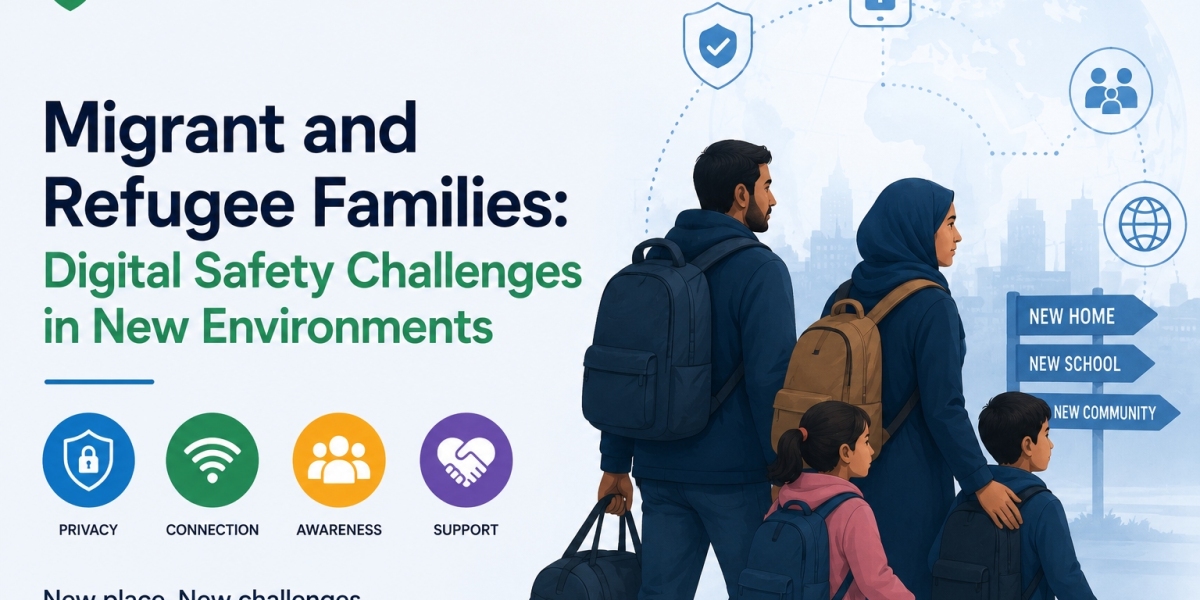

For many migrant and refugee families, digital technology serves as a lifeline. Smartphones, messaging apps, social media platforms, online learning tools, and digital government services help families stay connected, access information, find employment, navigate new communities, and maintain relationships across borders.
Yet while technology can support integration and opportunity, it can also introduce new risks. Families adapting to unfamiliar environments often encounter digital safety challenges that may be difficult to recognize or address, particularly when language barriers, limited digital literacy, economic constraints, and reduced support networks are involved.
As migration and displacement continue to shape communities around the world, understanding these digital safety concerns have become increasingly important. Protecting migrant and refugee families online is not simply a technology issue—it is closely connected to human rights, inclusion, education, and access to essential services.
Technology as a Critical Resource
For displaced families, digital tools often play a more significant role than they do for many other populations.
Technology may be used to:
- Communicate with relatives in other countries
- Access legal and immigration information
- Find housing and employment opportunities
- Enroll children in schools
- Access healthcare resources
- Learn local languages
- Navigate transportation systems
- Participate in community life
Because digital access is so important, online safety becomes a critical part of overall wellbeing.
A cyber scam, privacy breach, or exposure to harmful content can have consequences that extend beyond the digital world and affect a family's ability to settle successfully in a new environment.
Understanding the Unique Challenges
Migrant and refugee families are not a uniform group. Their experiences, backgrounds, and needs vary widely.
However, certain circumstances can create vulnerabilities during periods of transition.
Language Barriers
Many digital platforms, privacy settings, and online safety resources are designed primarily for dominant languages.
Families who are still learning a new language may find it difficult to:
- Understand security warnings
- Recognize scams
- Read privacy policies
- Configure safety settings
- Access support services
This can increase exposure to online risks.
Limited Familiarity With Local Digital Systems
New arrivals may not be familiar with:
- Government websites
- Educational portals
- Banking systems
- Local communication platforms
Scammers sometimes exploit this lack of familiarity by impersonating trusted institutions.
Reduced Support Networks
When families relocate, they may lose access to extended family members, community leaders, educators, and trusted advisors who previously helped them navigate challenges.
Without these support systems, identifying online threats can become more difficult.
Online Scams and Fraud Risks
One of the most common digital safety concerns involves scams.
Fraudsters often target individuals who are:
- Seeking employment
- Looking for housing
- Applying for immigration services
- Accessing financial assistance
Common scams may include:
- Fake job offers
- Fraudulent housing listings
- Phishing emails
- Identity theft schemes
- Impersonation of government agencies
Because newly arrived families often need urgent information and services, they can be particularly vulnerable to deceptive offers.
Digital literacy education can play a major role in reducing these risks.
Children's Online Safety
Children in migrant and refugee families often adapt quickly to new technologies and educational systems.
While this can be beneficial, it also creates challenges.
Young people may encounter:
- Cyberbullying
- Online harassment
- Inappropriate content
- Misinformation
- Predatory behavior
- Privacy risks
Parents who are still learning a language or becoming familiar with local technology systems may find it difficult to monitor online activities effectively.
This is why accessible online safety resources are important not only for children but also for caregivers.
Education and Digital Inclusion
Schools increasingly rely on digital platforms for:
- Assignments
- Communication
- Research
- Classroom collaboration
For migrant and refugee students, access to technology can support educational success and social integration.
However, digital inclusion must also include digital safety.
Students need guidance on:
- Unauthorized internet use
- Privacy Protection
- Identifying misinformation
- Safe social media practices
- Reporting harmful content
Educational institutions play an important role in helping families understand these issues.
Privacy and Data Protection Concerns
Privacy can be especially important for displaced individuals.
Some refugee families, for example, may have concerns about:
- Personal data collection
- Location tracking
- Online fence
- Identity Cheat
- Unauthorized information sharing
Understanding privacy settings and digital security practices can help reduce these risks.
Simple steps such as using strong passwords, enabling multi-factor authentication, and reviewing account permissions can make a significant difference.
Digital safety is not only about avoiding scams—it is also about maintaining control over personal information.
The Role of Accessible Safety Tools
Technology can also provide solutions.
Many families benefit from tools that help create safer online environments through:
- blocks separated
- Safe Browsing Settings
- Content controls
- Device management
- Educational resources
For example, BlockP is a free digital safety tool that can help families reduce exposure to inappropriate content and create safer online experiences across devices. As part of a broader digital literacy strategy, tools like these can support parents and caregivers who are navigating unfamiliar digital environments.
Technology works best when combined with education, communication, and ongoing support.
Community Support and Digital Literacy
Digital literacy is most effective when communities participate.
Local organizations, schools, libraries, and support groups often provide valuable assistance by offering:
- Art training
- Online safety talks
- Language-accessible resources
- Digital inclusion programs
- Family support services
These initiatives help reduce barriers and empower families to use technology confidently and safely.
Importantly, digital literacy should be viewed as a lifelong learning process rather than a one-time skill.
Building Trust and Confidence
For families adapting to a new environment, confidence in using technology is just as important as access itself.
Digital confidence grows when people:
- Understand how systems work
- Know where to find reliable information
- Feel comfortable asking questions
- Have access to trusted support
Creating inclusive digital environments helps ensure that technology becomes a tool for empowerment rather than a source of anxiety or risk.
A Human Rights Perspective
Access to information, education, communication, and digital participation are increasingly recognized as important components of modern life.
From a human rights perspective, everyone should have the opportunity to benefit from technology safely and equitably.
This means ensuring that:
- Digital services are accessible
- Safety resources are available in many languages
- Vulnerable populations receive support
- Privacy rights are respected
- Online environments are inclusive
Digital inclusion and digital safety must advance together.
Surgery
Migrant and refugee families often rely heavily on digital technology as they build new lives, access services, and stay connected with loved ones. While technology can create opportunities for education, employment, and community participation, it can also introduce risks that are amplified by language barriers, unfamiliar systems, and limited support networks.
Addressing these challenges requires a combination of digital literacy, accessible resources, supportive communities, and practical safety tools. By investing in inclusive digital safety strategies, societies can help ensure that displaced families are able to navigate online environments with confidence, security, and dignity.
Creating safer digital spaces is not only a technology goal—it is an important part of supporting successful integration, equal opportunity, and human wellbeing.
Frequently Asked Questions
What digital safety challenges do migrant families face?
Common challenges include language barriers, online scams, unfamiliar digital systems, privacy concerns, cyberbullying risks, rumors, and limited access to trusted support networks. These challenges can make it more difficult to identify and respond to online threats.
Are free safety tools accessible regardless of location?
Many free digital safety tools are available globally, although availability may vary depending on local laws, app stores, internet access, and device compatibility. Users should always verify availability and privacy practices before installing any tool.
What organizations support digital literacy for displaced communities?
Various international organizations, refugee-support agencies, educational institutions, libraries, community groups, and nonprofit organizations provide digital literacy training and online safety resources for migrants and displaced populations. Services vary by country and region.