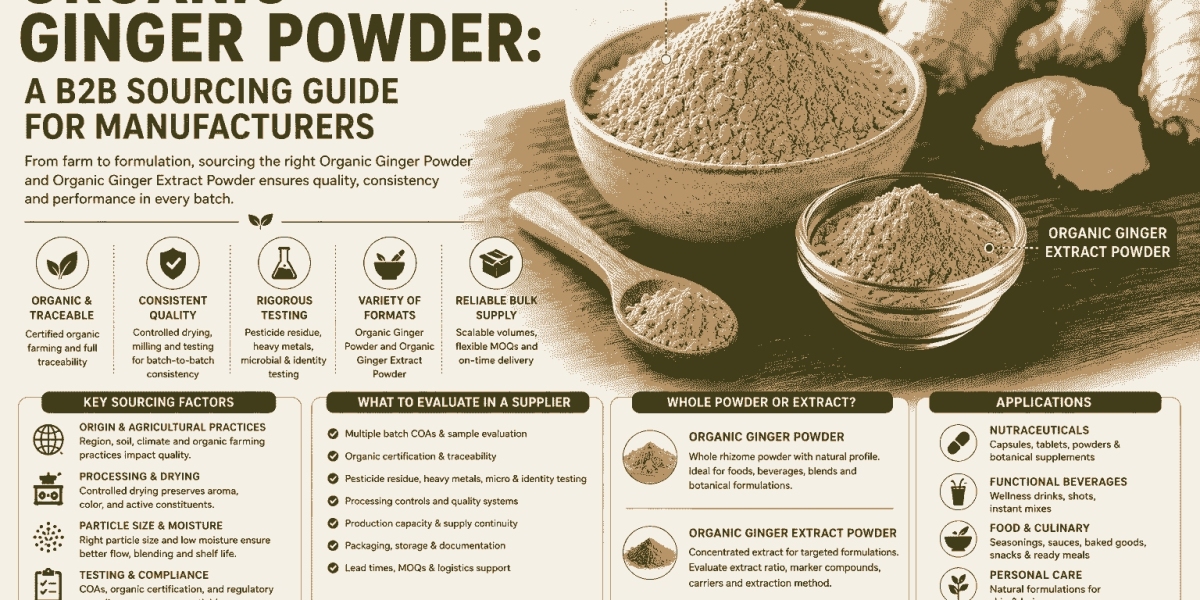

With Organic Ginger Powder and Organic Ginger Extract Powder, procurement decisions involve agricultural variability, processing controls, physical specifications, documentation, and supply continuity. Each factor can influence whether a material performs consistently from one production lot to the next.
For procurement managers working with RD and quality teams, the most effective approach is to treat ginger sourcing as a qualification process rather than a simple purchasing exercise.
Establish Exactly What the Formulation Requires
The first sourcing question should come from the formulation brief.
Organic Ginger Powder is produced from dried ginger rhizomes and milled into a powdered ingredient. It is generally considered when manufacturers want a whole botanical powder for applications such as dry blends, food formulations, beverage mixes, and botanical products.
Organic Ginger Extract Powder is produced through extraction and concentration. Depending on the product specification, the extract may have a defined extract ratio, marker compound, assay, or carrier system.
These are not interchangeable materials.
Before contacting suppliers, procurement teams should establish whether RD requires whole ginger powder or a concentrated extract. Doing this early prevents unnecessary supplier comparisons and helps purchasing teams evaluate quotations on a cost-in-use basis rather than price per kilogram.
Investigate the Agricultural Source
Ginger is an agricultural raw material, which means its characteristics can vary with crop conditions and post-harvest handling.
Commercial ginger is sourced from several producing regions, including India, China, Peru, and other parts of Asia. Soil conditions, cultivar, weather, harvest timing, and agricultural practices can influence the incoming raw material.
For organic sourcing, buyers should confirm:
- Botanical species and plant part
- Country and region of origin
- Organic certification status
- Harvest information where available
- Agricultural traceability
- Pesticide-residue controls
Country of origin should not automatically be treated as a quality ranking. Instead, it should be viewed as one part of the supplier's traceability and risk profile.
Examine Processing Controls
This is where two apparently similar ginger products can begin to behave differently.
For Organic Ginger Powder, drying and milling are particularly important. Drying conditions can influence moisture, aroma, color, and storage characteristics, while milling determines particle-size distribution and handling behavior.
For Organic Ginger Extract Powder, procurement teams need to investigate additional parameters, including:
- Extraction method
- Extract ratio
- Concentration process
- Marker or assay specifications
- Carrier materials
- Residual solvents where applicable
- Drying technology
One practical lesson from commercial sourcing is that the processing description should match the final specification. If a supplier cannot clearly explain how the ingredient is produced, it becomes difficult for RD and quality teams to predict batch performance.
Test More Than One Batch
A single sample can demonstrate that a supplier can produce an acceptable ingredient. It does not necessarily demonstrate consistency.
For commercial qualification, buyers should consider evaluating multiple recent lots. Physical observations can be particularly useful.
Teams may compare:
- Color
- Aroma
- Particle size
- Moisture
- Bulk density
- Flowability
- Dispersion
- Blend uniformity
For beverage applications, dispersion testing may be more important than it is for a dry capsule blend. For food manufacturing, aroma and color consistency may receive greater attention.
The testing program should therefore reflect the final application.
Review the Complete Quality Package
A COA is an important document, but it should sit within a broader supplier-quality package.
Depending on the intended application, procurement teams may request organic certification, identity testing, microbiological results, heavy metal analysis, pesticide-residue testing, allergen information, specifications, MSDS documentation, and country-of-origin records.
For extracts, additional documentation around assay, extract ratio, carriers, and processing may be required.
The objective is not to collect paperwork for its own sake. Each document should answer a practical question about ingredient identity, safety, consistency, or regulatory suitability.
Assess Commercial Supply Risk
A technically strong sample is not enough if the supplier cannot maintain supply.
Before approving a source for recurring orders, procurement teams should evaluate:
- Production capacity
- Minimum order quantities
- Lead times
- Finished-goods inventory
- Packaging formats
- Storage conditions
- Batch traceability
- Seasonal supply risks
- Logistics capability
- Contingency planning
This becomes especially important when the ingredient is used in a high-volume product where a delayed shipment could interrupt production.
Make the Decision With Total Cost in Mind
The cheapest quotation may not be the lowest-cost option once production factors are considered.
An ingredient that requires additional processing, creates blending problems, varies significantly between lots, or has unreliable lead times can increase the actual cost of manufacturing.
For Organic Ginger Powder, procurement teams should weigh raw-material consistency, physical properties, and supply reliability.
For Organic Ginger Extract Powder, the evaluation should also consider concentration, assay, extraction method, carrier content, and cost per finished-product application.
Conclusion
Effective ginger sourcing is ultimately a cross-functional process. Procurement establishes commercial requirements, RD evaluates formulation behavior, and quality teams verify compliance and consistency.
When manufacturers assess agricultural origin, processing controls, multiple production lots, documentation, and supply capability before placing recurring orders, they gain a much clearer understanding of supplier performance.
For companies sourcing Organic Ginger Powder or Organic Ginger Extract Powder, the strongest procurement strategy is therefore not based on price alone. It is based on predictable quality, transparent processing, application suitability, and the supplier's ability to maintain those standards as order volumes increase.