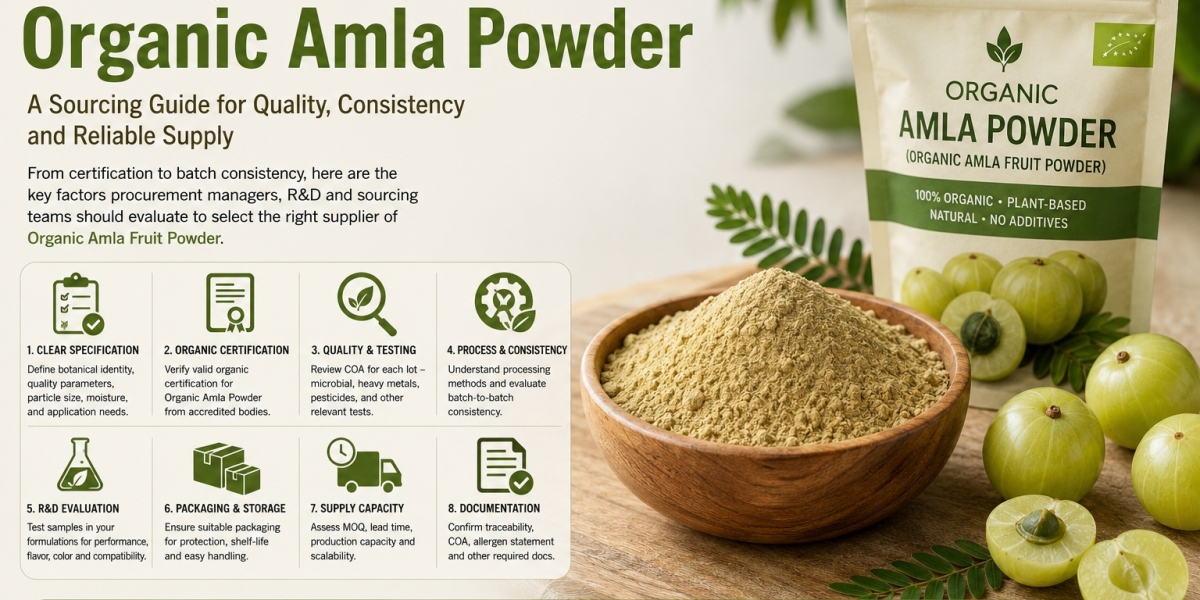

This is especially relevant when sourcing Organic Amla Powder for food, beverage, nutraceutical, dietary supplement, and wellness applications. Companies purchasing Organic Amla Fruit Powder also need to consider organic certification, traceability, batch consistency, and formulation suitability.
For procurement managers, formulators, R&D professionals, and sourcing teams, evaluating total sourcing cost can provide a more realistic basis for supplier selection.
Start With the Actual Requirement
Before comparing suppliers, procurement teams should define the company's actual requirement.
Important factors may include annual consumption, expected order frequency, packaging format, required specifications, certification requirements, and delivery schedule.
R&D teams should also communicate the formulation requirements so procurement does not source a material based only on price.
A clear purchasing requirement creates a stronger foundation for supplier comparison.
Look Beyond the Quoted Price
The price per kilogram is only one component of total sourcing cost.
A supplier offering a low unit price may require a large minimum order, creating additional inventory and storage costs. Another supplier may have a slightly higher price but provide smaller order quantities and more predictable deliveries.
When sourcing Organic Amla Powder, buyers should calculate the delivered and operational cost rather than relying exclusively on the quoted unit price.
Evaluate Minimum Order Quantities
MOQ can have a significant impact on working capital.
Large orders may reduce the unit price but can result in excess inventory if consumption is lower than expected.
Procurement teams should compare MOQ with actual production requirements and inventory turnover.
For manufacturers using Organic Amla Fruit Powder, an appropriate purchasing quantity should balance pricing advantages with storage capacity and demand forecasts.
Include Freight and Delivery Costs
Transportation should be included in supplier comparisons.
The final delivered cost can vary based on supplier location, shipment size, packaging, delivery frequency, and logistics arrangements.
A supplier with a competitive product price may not provide the lowest overall cost after freight is included.
Procurement teams should therefore compare suppliers using a consistent delivered-cost calculation.
Consider Quality-Related Costs
Quality problems can create costs beyond the purchase order.
If an incoming batch fails to meet specifications, manufacturers may need additional testing, replacement material, production adjustments, or disposal.
For this reason, supplier quality and batch consistency should be considered when evaluating Organic Amla Powder.
A reliable supplier may provide better long-term value even when its initial quotation is not the lowest.
Evaluate Organic Certification
For manufacturers purchasing Organic Amla Fruit Powder, certification should be part of the sourcing evaluation.
Procurement and quality teams should request current organic certification and verify that it applies to the relevant product.
Required documentation may also include:
- Certificate of Analysis
- Product specification
- Allergen statement
- Country-of-origin information
- Traceability documentation
- Shelf-life details
Complete documentation can reduce administrative delays during supplier approval and receiving.
Assess Formulation Performance
R&D teams should evaluate supplier samples in the intended application.
Depending on the formulation, testing may examine dispersion, blending, flowability, color, flavor, and processing behavior.
An ingredient that performs consistently can help reduce reformulation work and production adjustments.
These potential savings should be considered as part of the supplier's overall value.
Review Storage Requirements
Storage can add indirect costs to bulk ingredient sourcing.
Procurement and warehouse teams should consider package size, inventory volume, storage conditions, handling requirements, and stock rotation.
Buying larger quantities only makes commercial sense when the manufacturer has sufficient consumption and appropriate storage capacity.
Evaluate Lead-Time Reliability
Unpredictable lead times can force manufacturers to maintain additional safety stock or place emergency orders.
Supplier delivery performance should therefore be reviewed alongside quoted lead times.
A supplier capable of delivering Organic Amla Powder consistently according to schedule may reduce the need for excess inventory and last-minute purchasing.
Compare Supplier Capacity
Commercial demand can change quickly after a product launch.
Procurement teams should determine whether the supplier can support current and future requirements.
Key questions may include:
- What volumes can the supplier support?
- What are the standard lead times?
- What is the MOQ?
- Are multiple packaging formats available?
- Can production scale with demand?
Capacity should be considered before committing to a long-term supplier relationship.
Review the Supplier After Approval
Total sourcing value should be monitored over time.
Procurement teams can track pricing, delivery performance, quality issues, freight costs, and supplier responsiveness.
R&D can report any changes in formulation performance, while quality teams can monitor batch compliance.
Periodic reviews help determine whether the supplier continues to provide competitive value.
Conclusion
The true cost of sourcing Organic Amla Powder extends well beyond the initial price per kilogram.
For manufacturers purchasing Organic Amla Fruit Powder, MOQ, freight, quality, certification, storage, formulation performance, lead-time reliability, documentation, and supplier capacity can all influence the final sourcing value.
For procurement managers, formulators, R&D professionals, and sourcing teams, a total-cost approach provides a more complete way to evaluate suppliers.
The strongest sourcing decision is not necessarily the supplier with the cheapest quotation. It is the supplier that combines competitive pricing with consistent quality, reliable delivery, technical suitability, complete documentation, and the capacity to support long-term production requirements.