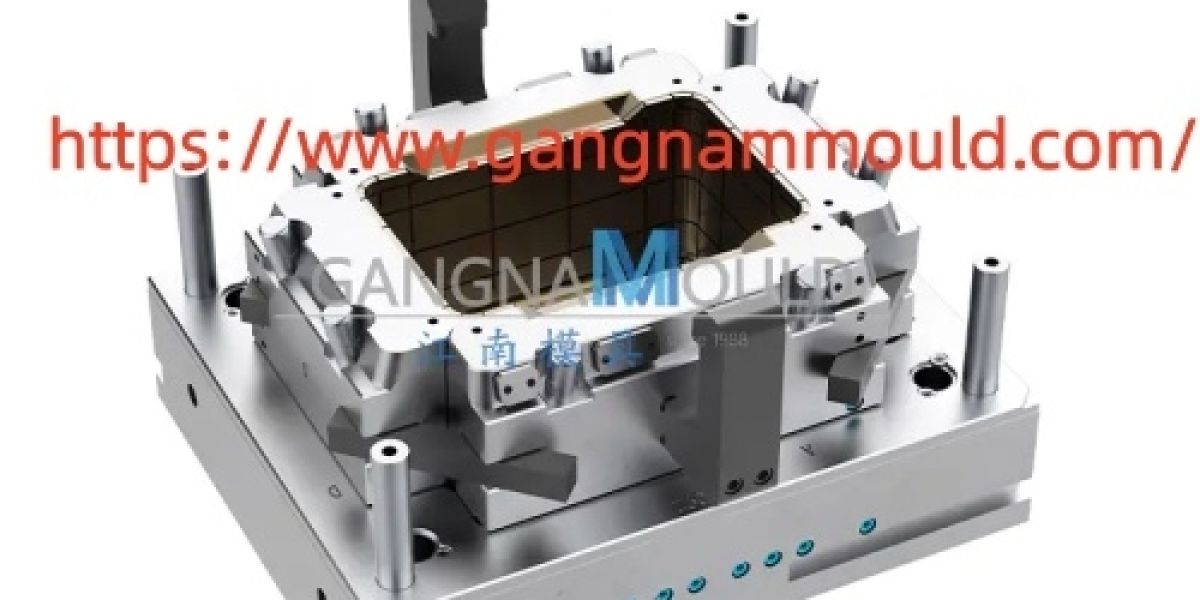

Turnover Box Mould cooling design plays an important role in production because heat must be removed from the plastic part before release. For reusable containers with broad surfaces, reinforcing ribs, corners, and varying wall sections, the thermal layout can influence cycle duration, dimensional stability, deformation, and surface appearance. Buyers should therefore review the cooling strategy during the tooling design stage rather than treating it as a secondary detail. Cooling time can account for a substantial portion of the injection cycle, so a carefully planned circuit deserves attention when discussing production requirements.
The shape of the product should guide the arrangement of water channels. A simple straight drilling pattern may be suitable for some areas, while deeper sections or complex surfaces can require a different approach. The distance between the channel and cavity surface, channel spacing, diameter, and circuit arrangement all influence heat transfer. These dimensions should be selected according to the material, wall thickness, steel structure, and available cooling equipment instead of applying one fixed layout to every project.
Wall thickness deserves special attention. When a product contains thicker ribs or reinforced corners, those sections generally retain heat longer than thinner areas. If the thermal balance is not considered during design, different areas may reach release conditions at different times. This can contribute to deformation or dimensional variation. A cooling layout that gives additional attention to thicker sections can help create a more balanced temperature distribution throughout the forming area.
The core side also requires careful planning. Deep internal structures can make heat removal more difficult, especially when conventional straight channels cannot approach the forming surface closely enough. Baffles, bubblers, or other cooling arrangements may be considered where space is limited. The appropriate solution depends on the geometry and available installation space. The cooling circuit must also avoid interference with ejector pins, screws, sliders, lifters, and other tooling components.
Flow balance is another important consideration. A cooling circuit should provide suitable coolant movement through the intended areas rather than leaving sections with limited flow. Series and parallel arrangements each have different characteristics, and the choice should consider pressure, flow rate, temperature rise, and the number of circuits. Independent circuits can also provide useful control when different regions require different thermal conditions.
Temperature control should be connected with the material being processed. Different polymers have different processing windows, shrinkage behavior, and thermal characteristics. The same cooling arrangement may therefore produce different results when the resin changes. Buyers should provide the intended material grade and production parameters before tooling begins. This information allows engineers to consider the relationship between resin behavior, cavity temperature, cooling capacity, and release requirements.
Gate areas can also deserve additional attention. Material entering the cavity carries significant heat, and areas near the gate may require sufficient heat removal. The gate location and cooling arrangement should therefore be reviewed together rather than designed independently. This type of coordination can help engineers identify areas that may require additional thermal control during the early design stage.
For complicated geometries, conformal cooling can be considered when conventional channels cannot provide a suitable path around the forming surface. Research has shown that channels following the contour of a component can support more uniform temperature distribution and may reduce cooling time. However, this approach can involve additional manufacturing complexity and cost, so it should be evaluated according to the actual project requirements rather than selected automatically.
Maintenance should remain part of the cooling discussion. Water channels need to remain accessible enough for inspection and cleaning, while connectors and circuits should be arranged with practical service in mind. Poor access can make routine maintenance more difficult. Buyers can ask for a cooling circuit diagram, inlet and outlet information, circuit grouping, and maintenance recommendations before approving the final design.
Gangnammould can work with customers on tooling projects where cooling requirements are connected with product geometry, resin selection, production volume, and machine conditions. During technical discussions, buyers can provide product drawings, material information, expected output, and equipment details. These inputs help the engineering team evaluate the thermal layout alongside cavity structure, ejection, gate placement, and other tooling elements.
A useful purchasing review should include channel position, channel diameter, circuit arrangement, coolant flow, temperature control, core cooling, cavity cooling, maintenance access, and potential interference with moving components. Buyers can also ask how the proposed design addresses thicker sections and whether a thermal simulation or production trial is appropriate for the project.
Cooling should not be treated as simply a collection of drilled passages. It is part of the relationship between material behavior, product geometry, production rhythm, and tooling structure. When these factors are considered together, buyers have a clearer basis for evaluating a customized solution. Customers can review Gangnammould tooling solutions and product information at https://www.gangnammould.com/product/ and discuss their drawings, material requirements, and production conditions with the manufacturing team.