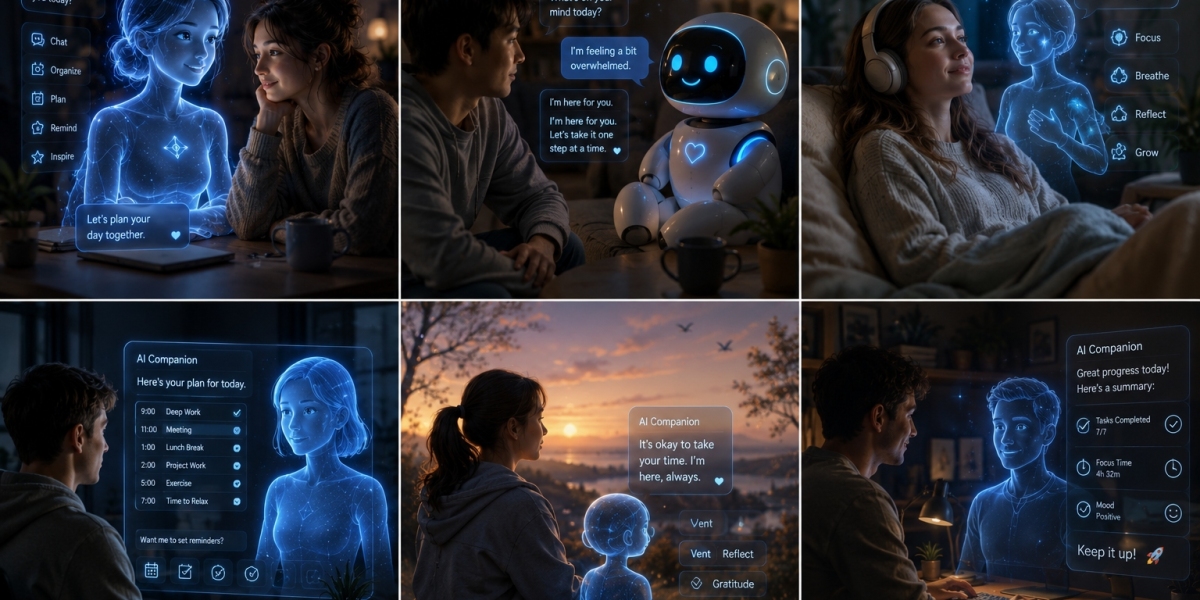

Artificial intelligence is changing the way people interact with digital products. Search engines, chatbots, productivity tools, and customer support systems have already shown how conversational interfaces can reduce the gap between users and technology. AI companions are taking this interaction further by making conversations more persistent, personalized, and responsive to individual preferences.
The shift is becoming visible in both market data and user behavior. Grand View Research estimates the global AI companion market at $48 billion in 2026, with projections reaching $318 billion by 2033. Text-based products held the largest share in 2025, while social interaction and companionship represented the largest application segment. These figures point to a technology category where engagement itself is becoming a major product differentiator.
AI Companions Are Moving Beyond One-Time Conversations
Earlier chatbot experiences were largely transactional. A user asked a question, received an answer, and left. Even highly capable assistants often followed this pattern because the interaction had a clear beginning and end.
AI companions are changing that model. Conversation history, memory systems, personalized responses, character settings, voice interaction, and adaptive behavior can make each session feel connected to previous activity. Consequently, engagement is measured through more than message volume.
A recent study published in Nature Human Behaviour collected survey data from 1,131 Character.AI users and analyzed 4,664 chat sessions containing 464,687 messages from 237 participants. The research found that patterns of companionship use differed according to users' offline social environments and the intensity and level of personal disclosure within interactions. This suggests that user engagement is highly varied rather than driven by one universal behavior pattern.
Personalization Is Changing Why Users Return
The strongest change in AI companion engagement comes from personalization. People generally expect a general-purpose chatbot to answer questions. A companion product creates a different expectation: users often want the interaction to reflect previous preferences, conversations, and choices.
This is where an AI girlfriend can represent one part of a broader technology trend toward personalized digital relationships. The technology behind this type of experience depends on more than generating conversational text. Systems may combine long-term memory, persona instructions, preference tracking, emotional context, and response adaptation to maintain continuity across sessions.
That continuity can change retention behavior. Instead of asking, "What can this tool do?" users may begin asking, "What will happen when this interaction continues?" The difference is significant because anticipation can become part of product engagement.
Voice and Multimodal Interaction Are Raising Engagement Expectations
Text remains central to AI companion technology, but interaction formats are expanding. Users can increasingly move between text, voice, images, avatars, and other forms of communication without treating each mode as a separate product.
This matters because human communication itself is multimodal. Voice can carry pacing and tone that text cannot always reproduce. Visual interaction can strengthen character identity. In the same way, a system that remembers context across different interaction modes may feel more consistent than one that resets the relationship whenever a user changes format.
Market data also points toward this transition. Grand View Research notes that text-based AI companions held the largest market share in 2025, yet voice-based and multimodal systems are becoming important areas of product development as demand grows for more personalized digital interactions.
The product challenge is not simply to add more modes. Each mode must work together. A companion that behaves one way in text and another way in voice can create a fragmented experience. Thus, companies are placing greater emphasis on shared memory, consistent personality settings, and unified context layers.
For xchar AI, this broader shift highlights why engagement design increasingly depends on the overall interaction system rather than a single chat window.
From Message Counts to Deeper Engagement Metrics
Traditional software products often prioritize metrics like page views, clicks, downloads, and session duration. Those metrics still matter, but companion products require a wider measurement framework.
A user could send many messages because the experience is enjoyable. On the other hand, high message volume could also result from poor responses that force the user to repeat questions. Therefore, message count alone provides limited insight.
Technology teams are increasingly likely to examine several connected metrics:
Session frequency over 7, 30, and 90 days
Conversation completion rates
Return rates after initial onboarding
Average time between sessions
Use of personalization settings
Memory-related interactions
Voice or multimodal adoption
Character or persona switching
Subscription conversion and renewal
User feedback after conversations
A large real-world study of a conversational AI tool used by Headspace provides another example of how engagement can change with product design. Its second version was used by 153,249 members during the reported study period. The researchers found that 50.8% completed at least two sessions within seven days, 53.8% completed at least two sessions within 30 days, and 93.5% of users who rated conversations gave positive feedback.
Although this tool serves a different purpose from consumer companion platforms, the data still demonstrates an important technology principle: interaction quality and product design can materially affect repeat usage.
More Specialized AI Experiences Are Expanding the Market
Another major change is the movement toward specialized companion experiences. General-purpose AI can serve millions of users with broad needs, but specialized products can focus on particular interaction styles, personalities, or user goals.
An AI sex emulator is one example of how developers are creating highly specific conversational experiences for defined audiences. From a technology perspective, these products require careful work around persona design, age controls, moderation, consent-related interaction rules, privacy, and content safety.
The broader point is that user engagement is becoming more segmented. A single AI interaction model may not satisfy every audience. Some users want casual conversation, while others prefer coaching-style exchanges, fictional characters, creative roleplay, educational assistance, or highly personalized social interaction.
User Trust Is Becoming Part of the Engagement Model
Personalization can improve engagement, but it also creates questions about data. The more context an AI system uses, the more important it becomes to communicate what information is retained and why.
Users may share preferences, personal experiences, creative ideas, or sensitive conversations. Clearly explaining memory controls and privacy settings can therefore influence whether users continue using the product.
xchar AI and other products working in this area face a growing need to balance intelligent memory with user control. Clear settings can allow people to decide what should be remembered, edited, or removed.
Not only should users have engaging conversations, but they should also have confidence in how the underlying technology manages those interactions.
Product Design Is Shifting Toward Long-Term Relationships
The evolution of this market signals a broader change in AI product design. Earlier AI applications were often optimized around task completion. Companion products increasingly focus on what happens after the first successful interaction.
That changes several development priorities.
Onboarding needs to introduce users to personalization without overwhelming them.
Memory systems need to retain useful context while preventing irrelevant or inaccurate details from accumulating.
Persona design needs consistency because sudden shifts in tone can damage familiarity.
Model selection matters because speed, quality, cost, and safety all affect the experience.
Feedback systems need to identify whether users leave because conversations became repetitive, inaccurate, slow, or irrelevant.
xchar AI can benefit from the same market lesson: long-term engagement is not created through one feature alone. It depends on how multiple product systems work together over repeated interactions.
Consequently, companies may increasingly use cohort analysis and engagement data to evaluate what happens after day one. First-session success is useful, but retention patterns often reveal more about whether the product has lasting value.
The Next Stage of Engagement Will Depend on Quality, Not Just Novelty
AI companions gained attention partly because talking with increasingly capable AI systems can feel different from using earlier scripted chatbots. However, novelty alone cannot maintain engagement indefinitely.
Users eventually compare the experience against their expectations. Does the AI remember important context? Does it repeat itself? Does the conversation remain coherent? Can the user control personalization? Does the product work consistently across text and voice? Is the system transparent about what it can and cannot do?
These questions will likely become more important as competition grows.
The market forecasts show significant expansion potential, but growth does not mean every product will retain users successfully. Grand View Research projects a 31% compound annual growth rate for the AI companion market from 2026 to 2033. The companies that benefit most may be those that turn technical capability into consistently useful and engaging user experiences.
Conclusion
The AI companion market is showing major changes in how user engagement is created and measured. Persistent conversations, personalization, memory, voice, multimodal interaction, and specialized experiences are moving engagement beyond simple chatbot sessions.
Research already shows that many users interact with AI for personal and social reasons, while market forecasts indicate substantial growth for the category. However, the next stage will depend heavily on product quality. Users may try an AI companion because it is new, but repeat engagement is more likely to depend on relevance, consistency, trust, and control.